Sickle Cell Disease
The gene for this disorder arose in Africa (and also probably in the eastern Arabian peninsula). The geographic distribution can also include countries bordering the Mediterranean Sea. Hemoglobin electrophoresis will indicate the presence of hemoglobin S.

In this disorder, an abnormality of the beta globin chain is present that consists of a single amino acid substitution. At the sixth amino acid position on the long beta globin chain molecule, valine is substituted for glutamic acid. This single substitution is enough to make the beta globin chain conformationally unstable, such that the beta globin has a tendency to become insoluble under conditions of hypoxia. RBC's containing large amounts of this abnormal beta globin have a tendency to collapse, or "sickle".
Sickle Cell Trait
In this condition, one abnormal beta globin gene is inherited on one chromosome 11, while the other is normal. This heterozygous state affords increased resistance to malaria caused by the more virulent Plasmodium falciparum. Persons with sickle trait are rarely seriously affected. Rare sickling may occur with hypoxia, and there may be microscopic hematuria, but a sickle "crisis" is extremely uncommon.

Laboratory findings with sickle trait include hemoglobin electrophoresis that demonstrates approximately 40 to 45% hemoglobin S, 55 to 60% hemoglobin A, and normal amounts (1 to 3%) of hemoglobin A2. A test for sickling can also be performed.
Sickle Cell Anemia
Persons with this condition have two abnormal beta globin chains per RBC, making the red cells very susceptible to sickling under conditions of hypoxia. Sickled RBC's can often be demonstrated on a peripheral blood smear. The hemoglobin electrophoresis will demonstrate 90 to 95% hemoglobin S, 1 to 3% hemoglobin A2, and 5 to 10% hemoglobin F. The sickle test will, of course, be positive.
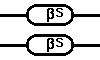
Complications of sickle cell anemia begin in childhood. There is a great tendency toward vaso-occlusive crises brought on by hypoxia. In these crises, so many RBC's sickle that the red cells stick together in small capillaries, impeding blood flow and causing tissue ischemia. Abdominal and back pain are particularly common symptoms, though muscle and joint pain can also be present. Renal injury leads to hematuria.
Though in early infancy the spleen may become large, later in infancy the multiple infarctions in spleen reduce splenic function, predisposing patients to infections, particularly with encapsulated bacterial organsisms such as pneumococcus. Eventually, there is "autosplenectomy" as the spleen shrinks to only a few grams in size.
The following images illustrate pathologic findings with sickle cell anemia:
 Next
Next Back
Back