|
On Friday, December 13, 1799, George Washington, recently retired as 1st President of the United States, developed a "cold" with mild hoarseness, but by 2 am the next morning he had difficulty breathing, with fever, throat pain, and difficulty swallowing. He was given the usual treatment of the time--bloodletting, with removal of about 400 mL. The first physician to arrive at 9 am, Dr. James Craik, supervised blistering agents applied to his throat, to draw off "toxins". Another 500 mL of blood was removed. An additional 500 mL of blood was removed at 9:30 am. He was given vinegar to gargle, which led to near fatal choking. Washington was still able to walk about his bedroom. Another physician, Elisha Dick, arrived and advised against further bloodletting, but another 1000 mL were removed at 3 pm. Dr. Gustavus Brown arrived and supervised administration of calomel (mercurous chloride) and tartar emetic (antimony potassium tartrate) as purgatives. Though Washington's condition temporarily improved, by 8 pm he was in greater respiratory distress. Further blistering agents were applied. Washington died at 10:20 pm.
Had vital signs been recorded, they may have shown temperature 37.9 C, pulse 115/min, respiratory rate 24/min, and blood pressure 90/60 mm Hg supine and 80/40 mm Hg sitting. An arterial blood gas may have shown pH 7.43, pO2 92 mm Hg, and pCO2 38 mm Hg with O2 saturation of 96%. His Hgb was 6.8 g/dL with Hct 18.2%, MCV 92 fL, platelet count 246,000/microliter, and WBC count 7720/microliter.
Questions:
6.1 What is his calculated O2 content?
O2 content = 1.34 x Hgb x saturation + (0.0031 x PO2)
O2 content = 1.34 x 6.8 x .96 + (0.0031 x 92)
O2 content = 9 mL O2/dL
6.2 What key factors affect this measurement? How could it have been improved in this case?
The amount of O2 content contributed by oxygen dissolved in the blood (0.0031 x PO2) is minimal compared to that carried by hemoglobin. The oxygen saturation of blood is an important determinant of total O2 content in blood, as is the hemoglobin level. When the PO2 is above 60 mm Hg, the Hgb remains saturated above 90%, so the "break point" for deterioration in saturation tends to come when the PO2 drops below 60 mm Hg.
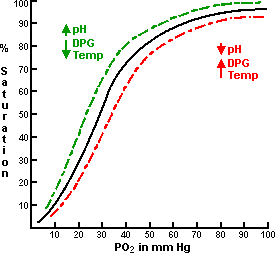
In comparison, for a patient with a good Hgb level:
O2 content = 1.34 x 15 g/dL x .95 + 0.0031 x 100 mm Hg
O2 content = 19.4 mL O2/dL
Thus, he patient could have used more RBC mass, and a 2 unit transfusion of packed RBCs would be given nowadays, given that he has physicial signs, including orthostatic hypotension and tachycardia, that indicate the need for more RBCs. The bloodletting markedly weakened many patients to whom this "therapy" was administered.
6.3 What physiologic changes occurred as a consequence of bloodletting and purging?
There would be a reduction in intravascular volume, which was sometimes observed to reduce swelling of inflammation, but this would also reduce tissue perfusion and lead to shock. Washington probably had an acute epiglottitis, which is still life-threatening today, but at the time his physicians had no effective anti-inflammatory therapy.
Historical note: Washington's death was, in part, attributed to the actions of his physicians, who attempted to justify their therapies, but this backfired, even though the most famous American physician of the time, Dr. Benjamin Rush, had won a malpractice case over his admonition of bloodletting, ironically on the day of Washington's death. Rush had graduated from Princeton University at age 15 and studied medicine at Edinburgh University. He developed the notion that disease classification was useless, and instead advocated use of about 20 to 30 medicines, particularly calomel ("Rush's thunderclappers") for treating all illnesses. He was a strong advocate for bloodletting, indicating that up to 4 liters (1 liter short of an average man's blood volume) should be removed. Though he signed the Declaration of Independence, supported establishment of universities, campaigned against slavery, and advocated education for women, his views on medicine were, in retrospect, dangerous, and amplified because about 3/4 of all physicians in the U.S. trained during his lifetime graduated from medical schools in the Philadelphia area, over which he had exerted his considerable influence.
|