|
A 37-year-old woman has noted loss of normal menstrual cycles in the past 6 months and increased growth of body hair. On physical examination her temperature is 37 C, pulse 70/min, respiratory rate 15/min, and blood pressure 145/95 mm Hg. Her motor strength is 4/5 in all extremities. She has fat redistribution centrally. Her body mass index is 33.
Questions:
5.1 What are possible causes?
The hypertension and fat redistribution suggest Cushing syndrome, but the virilization is more than what occurs just with Cushing syndrome. Could she have polycystic ovary syndrome (PCOS)? Could she have a tumor secreting androgens, either in the ovary or adrenal? Could she have a pituitary neoplasm?
5.2 What additional studies are needed?
Laboratory studies show serum prolactin of 5 ng/mL (normal 2 - 26 ng/mL). Her glucose is 188 mg/dL. Her LH is and FSH are decreased. Her ACTH is 2 pg/mL (normal 6 - 76 pg/mL). Her serum androgen level is increased. Serum testosterone is increased and urinary 17-KS are increased.
5.3 What radiographic findings do you expect?
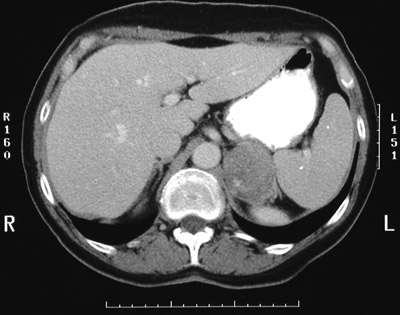
She has a 4 cm mass with focal necrosis and calcification involving the left adrenal gland. The ovaries (not seen here) are normal in size and appearance.
5.4 What is the diagnosis?
This is an adrenal cortical carcinoma which is functioning to produce hormones with both corticosteroid and androgenic effects, leading to features combining Cushing syndrome and masculinization.
In contrast, a patient with PCOS classically has 5 findings (polycystic ovaries, dysmenorrhea, hirsutism, obesity, and infertility) and laboratory studies demonstrate evidence of adrenal androgen excess, elevated estrogen levels, and abnormal gonadotrophin secretion. In PCOS there is lack of ovulation and lack of progesterone production with failure of ovulation. Increased LH is often seen in women of normal or decreased body weight with PCOS. Insulin resistance is typically present in women with PCOS who are overweight.
Cushing syndrome alone does not have features of masculinization. Adrenal cortical neoplasms (carcinoma or adenoma), adrenal hyperplasia (either primary adrenal or secondary to an ACTH-secreting pituitary adenoma), ectopic ACTH from a neoplasm such as a bronchogenic carcinoma, or exogenous corticosteroid use can all lead to Cushing syndrome.
|