|
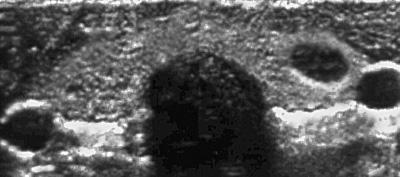
A 43-year-old previously healthy woman has a routine medical checkup. Her physician palpates a firm nodule in her left neck region. An ultrasound scan reveals the following:
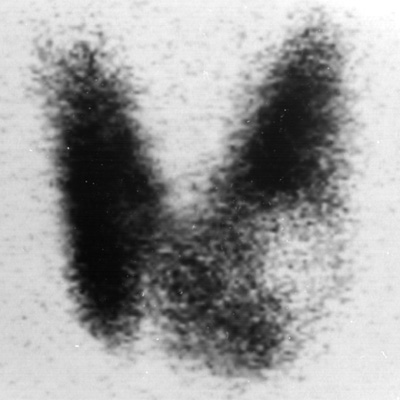
A radionuclide scan reveals the following:
A fine needle aspirate of the nodule is performed. She then undergoes thyroidectomy with the finding seen below:

Questions:
1.1 What is the diagnosis?
There is a left thyroid nodule with a follicular pattern, consistent with a follicular neoplasm, probably a follicular adenoma.
1.2 What testing is required in the immediate post-operative period? Hint: what is shown in the EKG below?
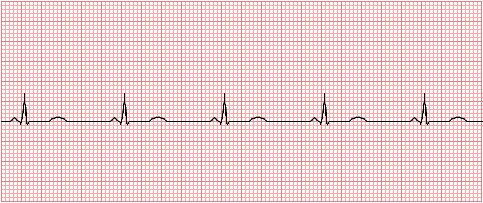
The EKG shows sinus bradycardia with a prolonged QT interval, consistent with diminished serum calcium (sometimes there are ST and T wave changes that mimic myocardial ischemia). Post-operatively, her serum calcium should be monitored, since the parathyroids may have been inadvertently removed or damaged by the surgery. Her serum calcium is 10.0 mg/dL.
1.3 What long-term complication should be monitored?
She may develop hypothyroidism. A month later her serum TSH is 6 mU/mL.
1.4 What therapy is indicated?
She requires hormone replacement therapy. This is typically accomplished with synthroid, which is relatively inexpensive (for a drug). The typical adult dose is 0.15 mg/day.
A month later her TSH is 3 mU/mL.
1.5 How do hormones affect their targets?
Hormones act via target cellular receptors. A hormone may downregulate the number of receptors, such as progesterone on the uterus; conversely upregulation increases the number of cellular receptors, and is seen with estrogen on the uterus and prolactin on the breast.
Hormones have no direct effect upon cells but bind to receptors and exert their action via a "second messenger", usually in 3 ways.
Many glycoprotein hormones such as FSH, TSH, and HCG act on G-coupled receptors to alter adenylyl cyclase to alter the amount of cyclic AMP, acting on protein kinases that phosphorylate proteins to exert an effect upon the cell.
Many steroid hormones such as cortisol, aldosterone, and estrogen, as well as thyroxine, bind to receptors within the cell nucleus to stimulate transcription of mRNA.
Hypothalamic hormones, including releasing hormones such as TRH and GNRH, and those traveling to the neurohypophysis (vasopressin and oxytocin), bind via a G-coupled receptor to phosopholipase C, which catalyzes formation of diacylglycerol and calcium release to activate protein kinases that phosphorylate proteins to exert an effect upon the cell.
|