|
A 75-year-old man visits an optometrist due to diminishing vision. The optometrist performs funduscopy and recognizes features of hypertensive retinopathy. He tells the man to visit a physician. On physical examination, vital signs include temperature 37 C, pulse 75/minute, respiratory rate 16/minute, and blood pressure 170/110 mm Hg. The remainder of the physical examination is unremarkable except for reduced range of motion at the knees and hips. His BMI is 28.
A chest radiograph shows a prominent left heart border along with calcification of the aortic knob. Laboratory studies show Hgb 13.5 g/dL, Hct 40.4%, MCV 80 fL, platelet count 186,000/microliter, WBC count 6380/microliter, serum sodium 143 mmol/L, potassium 4.2 mmol/L, chloride 105 mmol/L, CO2 24 mmol/L, glucose 128 mg/dL, creatinine 1.2 mg/dL, triglyceride 177 mg/dL, and total cholesterol 192 mg/dL.
Questions:
6.1 What is the diagnosis and what are risk factors?
He has hypertension. Blood pressure tends to go up with age, but not into this abnormal range. It is most likely that he has benign essential hypertension. The cost-effectiveness and yield from doing a more extensive workup without additional evidence is low. He does appear to have diabetes mellitus but not hyperlipidemia.
6.2 Explain the physiology of his condition.
Blood pressure regulation is a function of several factors. In a vessel, pressure is a function of volume and compliance:
P = V/C
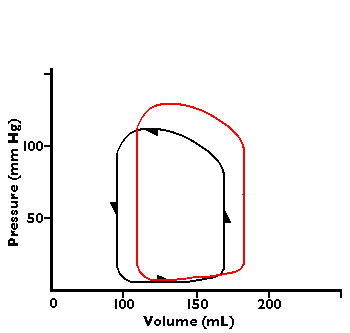
In arteries, the compliance diminishes with age, increasing the pressure. Atherosclerosis will decrease compliance. Systolic pressure will increase more than diastolic pressure.
The effect upon the heart from increased afterload is shown below:
6.3 In what condition would systolic pressure be reduced, but diastolic pressure be maintained?
Aortic stenosis.
6.4 What pharmacologic therapy is indicated for this man? Use your PDA to find specific agents and dosing regimens that the patient could reasonably follow, given that you have to avoid drug interactions or adverse events with his current medications, which include:
- Insulin
- Ibuprofen
- Allopurinol
- Cimetidine
- Warfarin
- Ginkgo biloba
Initial theapy is usually either a thiazide diuretic or an ACE inhibitor. If one alone is not sufficient to lower blood pressure adequately, then both are usually prescribed. If control of blood pressure is still not adequate with this combination, then another pharmacologic agent may be added, and this third agent is usually a beta-adrenergic blocker. If adding this third drug is still not sufficient, then an alpha-1 blocker or alpha-2 agonist may be used, or a direct vasodilator such as hydralazine or minoxidil.
Some concerns would include:
- The thiazide diuretics tend to cause hyperglycemia, potentially aggravating the patient's diabetes mellitus, and hyperuricemia, potentially aggravating his gout (assumed to be present since he is being treated with allopurinol).
- Cimetidine should not be used. It is an inhibitor of cytochrome p450, so it could elevated levels of warfarin and levels of a beta-blocker, if one were used.
- Beta-blockers tend to cause hypoglycemia, so that could complicate therapy for diabetes mellitus and probably make it a worse choice than an ACE inhibitor.
- Ginkgo biloba has some anticoagulant effects and should probably not be used along with warfarin.
Given the potential complications in this patient, and the degree of hypertension, an ACE inhibitor plus either an alpha-1 blocker or a vasodilator would seem reasonable approaches (though orthostatic hypotension and relfex tachycardia may be problems with the latter drugs).
| JNC VI Stratification of Cardiovascular Risk and Links to Initial Treatment Strategy
| | RISK GROUP | A | B | C
| | Number of Risk Factors | 0 | 1 (not DMa) | >2 (or DM)
| | Target organ damage | Absent | Absent | Present
| | Cardiovascular disease | Absent | Absent | Present
| | BP stage
| | High normal (130-139/85-89) | LM only | LM only | LM + drug
| | Stage 1 (140-159/90-99) | LM for 12mo | LM for 6 mo | LM + drug
| | Stage 2 (160-179/100-109) | LM + drug | LM + drug | LM + drug
| | Stage 3 (>180/>110) | LM + drug | LM + drug | LM + drug
|
DM = diabetes mellitus
LM = lifestyle modifications
|