|
A 10-year-old boy was riding his bike and fell, hitting his head on the ground. His mother found him unconscious, with a bloody forehead. She thought he was dead, but the boy regained consciousness before she could phone 911. She brings the boy to the emergency department. He has a small laceration to the forehead, which requires 5 sutures. A week later, she finds him collapsed on the ground, and he regains consciousness within 5 minutes. A trip to the emergency department yields no findings on physical examination. This scenario is repeated 4 more times in the next 6 months. Each time a different physician is on duty in the emergency department, and they have to repeat the historical findings each time. Her husband, having returned from a tour of military duty, accompanies her with the child on the 7th ED visit. He remarks that his Aunt Emma had similar episodes before she died suddenly at age 39.
Questions:
5.1 What conditions are in your differential diagnosis?
Epilepsy. Hypoglycemia. Anemia. Hypotension. Cardiac disease (arrhythmia)
5.2 What test(s) or procedure(s) would be helpful?
Laboratory test findings include serum sodium 143 mmol/L, potassium 4.2 mmol/L, chloride 104 mmol/L, CO2 26 mmol/L, glucose 73 mg/dL, and creatinine 1.0 mg/dL. A CBC shows Hgb 14.0 mg/dL, Hct 42.2%, MCV 90 fL, platelet count 249,100/microliter, and WBC count 7720/microliter.
A standard electrocardiogram (EKG or ECG) is the best test for diagnosing LQTS. An exercise EKG, also known as a stress test, can show an abnormal Q-T interval that may otherwise be normal during a resting EKG. A 24 hour monitoring (Holter monitoring) gets a continuous reading for heart rate and rhythm which can be examined for episodic occurrences of an abnormality.
What is shown here?
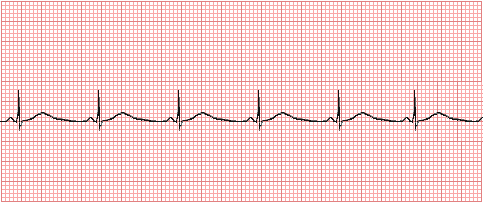
The EKG shows a long QT interval.
5.3 What complication is shown here?

This life-threatening arrhythmia is known as torsades des pointes. It is marked by a ventricular tachycardia with highly irregular rhythm and widened QRS complex.
5.4 What causes this finding?
Long Q-T syndrome (LQTS) is a disorder of cardiac repolarization involving an ion channel. LQTS most often affects children or young adults. The risk for LQTS is increased if other family members have the disorder. Drugs including antiarrhythmics and antidepressants can increase the risk for LQTS. It can result from stroke or other neurologic disorder. It can be congenital.
Some persons with LQTS may be asymptomatic. The most common manifestations are syncope and arrhythmia. The LQTS may be exacerbated by exercise, intense emotion, or fright. LQTS may not manifest a prolonged Q-T interval all the time, so the disorder is sometimes overlooked during a routine physical exam. A family history is helpful for diagnosis, particularly a history of repeated episodes of fainting or a history of sudden death. There is often at least one syncopal episode by the age of 10, but some persons no longer have symptoms as adults.
5.5 What can be done?
Treatment for LQTS may include lifestyle changes, medicines, or surgery.
Lifestyle changes: persons with LQTS may need to participate in exercise or sports in moderation.
Pharmacologic therapy: beta-blockers are the most common therapy for LQTS.
Surgery: uncontrolled ventricular fibrillation may require an implantable cardioverter defibrillator (ICD).
|