Clinical History:
A 34-year-old woman has experienced increasing difficulty with activities that involve movement over the past year. She now finds it hard to climb even one flight of stairs. She cannot lift a chair and carry it across a room. She cannot walk more than 300 m.
On examination, she has no muscle tenderness, but large proximal muscle groups exhibit decreased tone. She has 3/5 motor strength in upper and lower extremities for proximal muscles such as quadriceps and biceps femoris, gluteal muscles, deltoids, and biceps brachii. There is 4/5 motor strength for distal muscle groups in hands and feet.
Laboratory studies show Hgb 14 g/dL, creatinine 0.8 mg/dL, and creatine kinase 155 U/L. The results of electromyography are shown here:
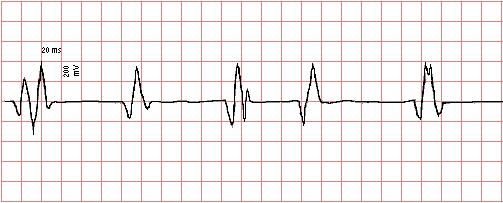
This EMG shows a "neurogenic" pattern with discharges characterized by irregular discharges of longer duration that may have an incomplete or reduced interference pattern leading to polyphasic configurations of near normal amplitude.
-
- What is seen on light microscopy?
- A. Marked variation in myofiber size and marked fibrosis between fibers
- B. Acute inflammation with necrosis and abscess formation
- C. Grouped atrophy of myofibers without inflammation or fibrosis
- D. Extensive lymphocytic infiltrates between myofibers
- E. Infiltration of myofibers by hyperchromatic and pleomorphic cells
|
Answer: C The grouped atrophy is characteristic for a neurogenic muscular disease.
Further history:
Six months later she develops difficulty speaking and swallowing. Explain the pathogenesis of her disease and correlate with the findings above.
There is progressive loss of lower motor neurons, typically anterior horn cells in the spinal cord, explaining her weakness in extremities. The manifestations are more prominent in the larger, more proximal muscle groups. There can be loss of motor neurons in the cranial nerve nuclei of the brainstem, such as those supplying the glossopharyngeal and hypoglossal nerves, leading to dysarthria and dysphagia. The problems with swallowing can predispose to aspiration. There can also be loss of upper motor neurons (Betz cells) in layer five of the the motor cortex.
The diagnosis is made with involvement of three of the following four sites: bulbar, cervical, thoracic, and lumbosacral motor neurons. A "probable" diagnosis is made when two sites are involved. The progressive nature of ALS will establish a diagnosis, and the median survival is 3 to 5 years. The incidence of ALS is 1 to 3 per 100,000. There is a rare familial form of ALS, with features of neurogenic muscular atrophy indistinguishable from the sporadic form of ALS, that is inherited in an autosomal dominant pattern.
|
|