Clinical History:
- A 9-year-old boy has had difficulty hearing on the right. As a child, he had multiple episodes of otitis media. This progressed to chronic otitis media on the right, with persistent drainage, and the tympanic membrane ruptured when he was a teenager. Since that time hearing in his right ear has been diminished.
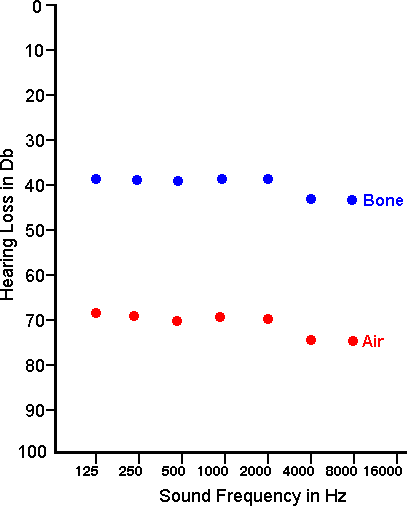
His audiogram on the right is shown here:
Questions:
- What are common infectious agents that produce acute otitis media?
Streptococcus pneumoniae and Hemophilus influenzae are the most common organisms cultured.
- What type of hearing loss is he most likely to have?
He is most likely to have conduction hearing loss, not nerve deafness, from involvement of the middle ear. Note that the audiogram shows the air conduction loss is greater than bone conduction loss, typical for a conductive hearing loss.
- How is serous otitis media caused in children?
There is blockage of the eustachion tube leading from the middle ear to the lower pharynx. This usually occurs as a result of upper respiratory or pharyngeal infections, such as tonsillitis.
Radiology and Microscopic Pathology:
- The appearance of the lesion with CT (image 1.1) reveals that the mass involves the middle ear and erodes into the mastoid bone. After surgical removal and pathologic examination, the histologic findings include a squamous epithelial lining of the cystic mass that is filled with keratinaceous debris. Around the cyst is an inflammatory infiltrate, mainly of round cells, but also with multinucleated giant cells and cholesterol clefts. (images 1.2 and 1.3).
Questions:
- What is the name for this mass lesion?
This is a cholesteatoma. It is not a true neoplasm, but an expanding cyst that can erode surrounding middle ear and bony structures.
- How does this lesion occur?
Inflammation with rupture of the tympanic membrane can result in a small amount of squamous epithelium becoming embedded in the middle ear, where it continues to proliferate, formaing an expanding cystic mass. Over time, the mass can erode the mastoid bone and destroy structures in the middle ear.
- Name a cause for progressive hearing loss in the elderly
Otosclerosis results from bony ankylosis of the ossicles. It also causes a hearing loss of the conduction type.
|
|