OBJECTIVE:
- Apply your knowledge of basic pathologic processes to interpret clinical history and pathologic findings to understand mechanisms and patterns of disease with aging.
CASE 1
(Click here to go to the answers)
Match the following case histories with one of the pathologic conditions listed here:
History A: A 77-year-old woman has decreasing vision, worse in her left eye. The center of her visual fields is more prominently affected. It is difficult to view the retina on funduscopic examination. Her intraocular pressure is normal.
History B: A 63-year-old man has noted decreased visual acuity and goes to an optometrist for a new pair of glasses. The optometrist notes excavation of the optic cup of both eyes on funduscopic examination. The intraocular pressure is increased.
History C: A 70-year-old man has had decreasing visual acuity for several years. The center of his visual fields is most affected. Funduscopic examination by an ophthalmologist reveals discrete thickenings called drusen in the retina, but no exudates, and there is atrophy of the retinal pigment epithelium. The intraocular pressure is normal.
Questions:
- Explain the pathophysiology of these conditions.
- What are possible interventions/outcomes for these conditions?
|
CASE 2
(Click here to go to the answers)
Clinical History:
- A 46-year-old man has had increasing difficulty with reading, particularly the fine print. In fact, everything seems to resemble fine print, because has to hold objects farther away in order to get them into focus. This problem has been getting worse for a couple of years. He still has no problems driving or with activities of daily living. He has resisted going to an optometrist, because he has never worn glasses and does not want to start now.
Questions:
- What is the most likely reason for these findings?
- What can be done?
- What is the incidence of this condition?
|
CASE 3
(Click here to go to the answers)
Clinical History:
History: A 56-year-old man and his wife have the following conversation:
Wife: "You never seem to listen to me anymore. I have to keep repeating myself."
Husband: "What?"
Wife: "There you go again. Am I insignificant to you?"
Husband: "Huh?"
An audiogram is shown here:
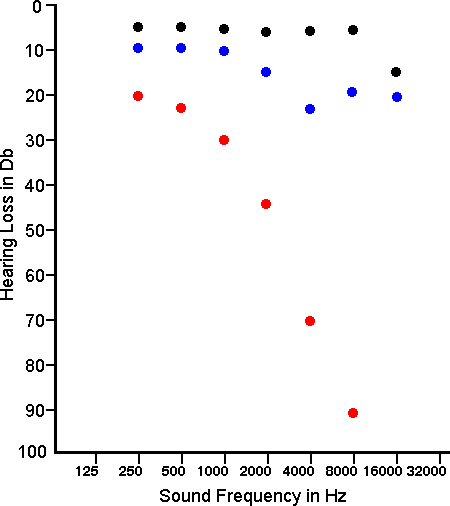
Questions:
- Why is this marriage tanking?
- How do you interpret the audiogram (3 patients represented)?
- What diseases could lead to these findings?
- How are they distinguished on physical examination?
|
CASE 4
(Click here to go to the answers)
Clinical History:
- The husband and two adult children of a 68-year-old woman are concerned that she is just not what she used to be mentally. Over the past year she has exhibited worsening ability to perform routine tasks. She can no longer keep track of her finances, and her husband has to handle the checkbook and bills. Her husband comes home from work to find that she has not bothered to prepare any dinner, even though she has done this since her own retirement at age 60 from a grade school teaching position. Last week, a neighbor found her wandering several blocks away from her home. She has had no major illnesses in her entire life. She has had no major surgeries.
- A week ago, her husband took her to the physician because she had been sleeping poorly, and getting him up at night. The physician prescribed lorazepam. After starting the drug, she had worse difficulties with concentration and attention, particularly in the evening, and couldn't remember what happened 5 minutes ago. Last night she suddently became very agitated and reported 'seeing things' in the corner of the dining room.
Questions:
- Is this to be expected with aging?
- What are the possibilities?
- How are these conditions diagnosed?
- What is the prognosis?
|
CASE 5
(Click here to go to the answers)
Clinical History:
- A 73-year-old woman with Parkinson disease falls down a flight of stairs in her home and immediately experiences severe pain in her right hip. She is taken by ambulance to a local hospital. On examination there is marked pain with any movement of her right leg. The right leg is shortened. She has an irregularly irregular heart rate. She becomes incontinent of urine while waiting to have radiographs taken. Radiographs reveal a right femoral neck fracture.
Questions:
- Describe predisposing factors for this event?
- How can risk be assessed?
- What are consequences of this event?
- What can be done to treat underlying conditions?
- What ethical issues need to be considered regarding treatment?
|
CASE 6
(Click here to go to the answers)
Clinical History:
- A 63-year-old man has had increasing fatigue for the past year, ever since his wife died. He has stopped going out every Saturday with his friends. He is unhappy and bored and feels sad. He now sleeps late every morning. He has lost 7 kg in the past year.
- Physical examination reveals 5/5 motor strength in all extremities, Deep tendon reflexes are normal. Sensation is intact. His mental status has not declined. A CBC shows WBC count 8400/microliter, Hgb 10.8 g/dL, Hct 31.9%, MCV 91 fL, and platelet count 188,000/microliter. A serum chemistry panel shows sodium 145 mmol/L, potassium 4.5 mmol/L, chloride 101 mmol/L, CO2 26 mmol/L, urea nitrogen 48 mg/dL, creatinine 5.0 mg/dL, and glucose 120 mg/dL.
Questions:
- What does the history suggest?
- What do the laboratory findings suggest?
- Give possible etiologies.
- What other workup would you perform at this point?
|
CASE 7
(Click here to go to the answers)
Clinical History:
- A 68-year-old man complains of increasing difficulty with movement. The pain is worse with activity and as the day progresses. His knees are primarily affected, left worse than right. You perform a physical examination and find that there is decreased range of motion, but no redness or swelling or joint deformity. Radiographs reveal joint space narrowing at the knee, with osteophyte formation involving the tibias. Bone density appears normal.
Questions:
- What are the possible explanations for these findings?
- What interventions are possible?
|
CASE 8
(Click here to go to the answers)
Clinical History:
- An 81-year-old woman has markedly reduced tolerance for physical activity. She becomes tired and short of breath very easily. At the end of the day, her feet and lower legs are always swollen, but not red or tender. For the past year, she has difficulty breathing at night unless she props herself up on a couple of pillows. She reports that, once or twice a week, her heart seems to "flutter" for several minutes and she becomes faint if standing has has to lay down.
Questions:
- Explain the pathophysiology of these findings.
- What conditions may have led to this set of findings?
- What is the role of hospice care in this case?
|
|
 Return to the
Laboratory Menu.
Return to the
Laboratory Menu.