- Type III: Antigen-antibody complex formation
- Case Presentation:
 History: A 40 year old woman has started a business that, both literally and figuratively, has "gone to the birds." She has begun raising and selling macaws and parrots. The birds are housed in a large cage in one room of her house. Since starting the business, she has had progressively worsening respiratory distress, with a non-productive cough. Her symptoms improve after she goes away to visit her sister for a few days. However, several hours after returning to her own home, the respiratory problems resume. History: A 40 year old woman has started a business that, both literally and figuratively, has "gone to the birds." She has begun raising and selling macaws and parrots. The birds are housed in a large cage in one room of her house. Since starting the business, she has had progressively worsening respiratory distress, with a non-productive cough. Her symptoms improve after she goes away to visit her sister for a few days. However, several hours after returning to her own home, the respiratory problems resume.
- What do these findings suggest?
- The timing of the symptoms suggests an environmental problem. There is a reaction to the birds, or more specifically, a bird component-bird dust. Feathers are lubricated and kept functional with a fine powdery substance known as bird dust. You don't notice this until you have a lot of birds in a confined space. This is one form of hypersensitivity pneumonitis. (BTW - canaries make less dust than other birds and may not be a problem in numbers if kept indoors.)
- What is the immunologic reaction?
- The bird dust is acting as an antigen to produce an antibody response. Ordinarily, the immune response produces a localized reaction. Production of antibody is targeted at specific sites where an infection is present. The antibody is bound and the inflammatory response produced in a localized fashion. However, in some persons, an ongoing infection or an autoimmune condition or exposure to an antigen can lead to the ongoing production of antibody. In these persons, there is enough antigen and antibody to form antigen-antibody complexes. These complexes continue to form as long as the antigen is present. The complexes can form at specific sites or within the circulatory system. Some of the complexes are removed by the mononuclear phagocyte system, but not all.
Hypersensitivity Pneumonitis
- Complexes formed of antibody with higher avidity or antigens with specific tissue affinity will also determine the pattern of distribution. Circulating immune complexes tend to deposit at tissue interfaces with basement membranes where they become trapped. Complement activation occurs and yields biologically active fragments that increase neutrophilic infiltration, promote phagocytosis, increase vascular permeability, and damage cell membranes. Proteases released by attracted neutrophils lead to further tissue damage.
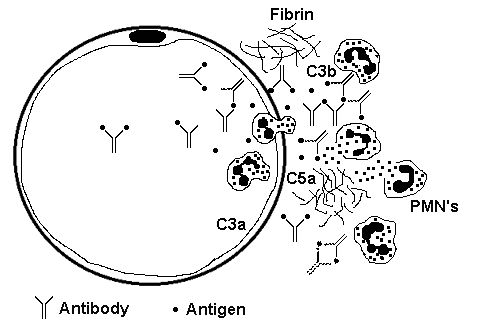
- Many autoimmune diseases have a component of antigen-antibody complex formation through which tissue injury is mediated.
- If hypersensitivity pneumonitis goes on for weeks to months, an element of type IV hypersensitivity develops in the lung, with granuloma formation.
- Type IV: Delayed-type hypersensitivity
- Case presentation:
- History: A 33 year old woman recently returned from a vacation in which she and her husband and two children were camping most of the time. The day following her return, she notices a red rash over areas of her arms and legs, primarily lower legs and forearms. The rash is composed of slightly raised, irregularly shaped red bumps from 0.5 to 2 cm in size. The rash is intensely pruritic. Palpation of these areas reveals a firm, indurated feel to the bumps. The rash continues to increase in intensity for the next two days. The rash gradually subsides over the next 10 days. She does not have a similar problem until another camping trip the following year. Her husband and children are not affected by this process.
- What do these findings suggest?
- The distribution of the rash could be consistent with an environmental exposure to an agent causing the rash. Photosensitivity is possible, but this usually has an onset that is not so delayed. Sunburn is distributed more evenly and is not typically indurated. The appearance of the rash a day or more following the exposure suggests a delayed phenomenon. A reaction to something she ate (type I hypersensitivity) is more widely distributed and appears more rapidly.
- What is the diagnosis?
- An exaggerated abnormal immune response from exposure to an antigen can be seen in the form of contact dermatitis. Some antigens, such as those contained in posion ivy, are better at producing this response than others. Some persons are more prone to develop this response than others.
Contact Dermatitis
- Explain the pathophysiology of this condition.
- In the initial encounter with an antigen, a minimal inflammatory response is produced. However, memory T cells are produced. Re-encounter with the antigen starts the type IV response, which is not immediate, but requires 2 to 48 hours to appear. The inflammatory response reaches a peak in 2 to 3 days, and then takes a week or more to subside. Only areas of skin which came into contact with the allergen are affected.
- This form of hypersensitivity reaction is based upon the cell-mediated immune response with CD4 and CD8 cells involved. Previous sensitization with an antigen may produce long-lived CD4 lymphocytes. These CD4 cells can recognize the antigen upon a further encounter when antigen presenting cells with MHC class II molecules. This encounter results in the release of a variety of cytokines, including interleukin-1, interferon-gamma, and tumor necrosis factor-alpha. The cytokines attract blood monocytes which become tissue macrophages. The released cytokines recruit additional lymphocytes and macrophages. Tissue injury is mediated by macrophages and endothelial cell cytokines and chemical mediators released by this reaction. This form of immune response with granulomatous inflammation is useful for combating infections with mycobacteria and fungi.
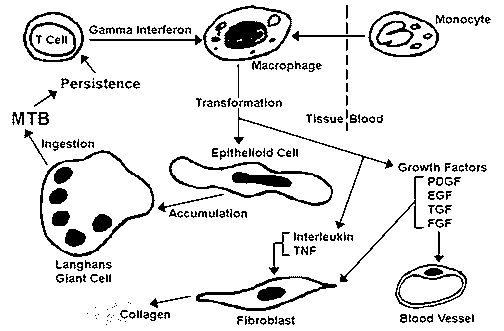
- How does skin testing make use of this mechanism?
- Skin tests for a variety of infectious agents exist for the purpose of diagnosing whether prior infection has occurred. The best known of these is the tuberculin skin test. A small quantity of "purified protein derivative" or PPD from cultured M tuberculosis is injected into the superficial skin. The cell-mediated immune system with its memory cells will react if a prior infection has occurred, giving rise to a red indurated area within 1 to 3 days. Other tests include lepromin (M. leprae), histoplasmin (H. capsulatum), and coccidiodin (C. immitis).
- One other purpose of skin testing is evaluation of the cell mediated immune system itself. There are some infections that nearly every adult has encountered, such as Candida and mumps. Injection of these agents should elicit a response. If no response is elicited, then the immune system is not intact. Such a person is said to demonstrate skin test "anergy".
|
 Return to the Immunology Course Outline