- Case Presentation: Type I Hypersensitivity
 History: A 33 year old woman is working in the garden behind her house. She is pruning a tree, and in the process disturbs a nest of bees. One of the bees stings her on the arm. She runs back into the house with the bees in pursuit. Within minutes she has pain and swelling of her arm. She begins to notice blotchy areas of redness on other areas of skin. Her heart is racing and she feels light-headed. She then has difficulty breathing, unable to get air in and out of her lungs. Her husband walks in at that moment and calls emergency services. Paramedics arrive in 10 minutes and find that she is hypotensive and barely breathing. History: A 33 year old woman is working in the garden behind her house. She is pruning a tree, and in the process disturbs a nest of bees. One of the bees stings her on the arm. She runs back into the house with the bees in pursuit. Within minutes she has pain and swelling of her arm. She begins to notice blotchy areas of redness on other areas of skin. Her heart is racing and she feels light-headed. She then has difficulty breathing, unable to get air in and out of her lungs. Her husband walks in at that moment and calls emergency services. Paramedics arrive in 10 minutes and find that she is hypotensive and barely breathing.
- What do the paramedics use as the initial therapy?
- They give her an injection of epinephrine, which improves her condition substantially.
- What condition has she suffered?
- She has had an immediate hypersensitivity reaction with systemic anaphylaxis.
- What is the immunologic basis for this condition?
- This type of immune response is based upon the body's defense against parasitic infections, with generation of CD4 lymphocytes of the TH2 variety. The cytokines secreted by the TH2 CD4 cells are predominantly interleukin 4, which stimulates B cells to produce predominantly IgE antibody, and interleukin 5, which activates eosinophils.
- However, in up to 10% of persons, this response is exaggerated against a variety of antigens. These persons are said to exhibit "atopy" or allergy. The antigens that elicit this response are known as allergens. Classic allergens include plant pollens, foods such as seafood, insect venom (bee sting), and some drugs.
- The initial encounter with the allergen stimulates a response that includes TH2 cells which promote production of IgE. The IgE is preferentially bound to the Fc receptors of mast cells. Mast cells are components of the immune system which are similar to circulating basophils. Mast cells are full of granules containing a variety of vasoactive substances. Mast cells tend to be concentrated around blood vessels and in the mucosa of respiratory and gastrointestinal tracts. This coating of mast cells with IgE is called sensitization. What distinguishes the atopic person's mast cells is the amount of specific IgE that is bound. In non-atopic persons, only small amounts of IgE for any particular allergen are bound.
- Upon re-encounter with the allergen, there is cross-linking of the bound IgE, which triggers the mast cell to release its granules. The granules containing vasoactive substances such as histamine have an immediate effect upon the surrounding tissues, particularly the blood vessels. The vessels become "leaky" and there is fluid exudation to produce edema (swelling). Arachidonic acid metabolites and cytokines are also produced. The major arachidonic acid metabolites are prostaglandins, via the cyclo-oxygenase pathway, which produce vascular dilation to promote edema, and leukotrienes, via the lipo-oxygenase pathway, to promote smooth muscle contraction, particularly in airways (bronchoconstriction). Cytokines such as TNF attract neutrophils. Proteases are released that produce tissue damage.

- Is there a milder form of this condition?
- Immediate hypersensitivity reactions can be subclassified into local and systemic. Local reactions are limited to a particular region, such as the upper airways with hay fever from plant pollen inhalation. Systemic responses are more widespread, as is evidenced with a penicillin allergy resulting in widespread vasodilation leading to shock.
- What is the basis for pharmacologic therapy?
- Drugs that block this response work in a variety of ways. Antihistamines block histaminic responses. Drugs can block leukotriene action, such as montelukast that is a leukotriene receptor antagonist. The beta-adrenergic drugs such as epinephrine stimulate smooth muscle to relax. Corticosteroids tend to deplete the lymphocytes, including the CD4 cells of the TH2 variety that drive the hypersensitivity reaction.
- What other therapy is available?
- A longer-term method of treating allergies is the identification of specific allergens (via patch testing on skin) followed by weekly administration of small amounts of the allergen. The goal of this therapy is to gradually deplete the IgE and replace it with IgG on the mast cells, thus preventing a serious hypersensitivity response.
- Avoiding the allergen is a strategy that is often used. If you are allergic to cats or dogs, then you do not have such animals in your house. You can avoid eating foods known to have allergens to which you react. You can install filtration devices in air handling systems in homes and offices to remove allergens from the air.
- Type II: Responses mediated through antibody attachment to cells
- This set of hypersensitivity responses is diverse.
- Case presentation: Type II Hypersensitivity
- History: A 50 year old woman has mid-abdominal pain that has increased in intensity over the past two days. She has been taking up to 10 ibuprofen tablets per day for "chronic arthritis" for several years. On physical examination, she has no significant findings except for a stool positive for occult blood. A CBC shows a WBC count of 7770/microliter, Hgb 8.6 g/dL, Hct 25.1%, MCV 74 fL, and platelet count 331,000/microliter. An upper endoscopy is performed, and she has evidence for a diffuse gastropathy. A day later, her Hct has dropped to 23.7%. A type and crossmatch is ordered for two units of packed red blood cells. About 20 minutes after the first unit has started transfusing, she develops a fever. A blood specimen is drawn as part of a workup for transfusion reaction. The serum is pink.
- Upon inspection, the unit of blood she received is type A, Her blood type is O.
- What has happened?
- She has a hemolytic transfusion reaction.
- How has this occurred?
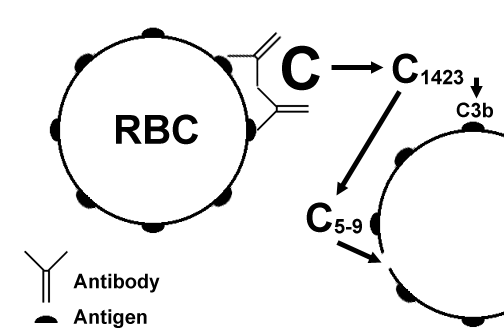
- Since her blood type is O, she has naturally occuring antibodies to red cell antigens A and B. Her blood contains circulating anti-A and anti-B antibodies. When she received the unit of A blood, her anti-A antibodies attached to the surface of the A red blood cells. The attached antibodies set off the classic complement pathway, because C1 can crosslink two Fc portions of closely positioned Ig molecules on the RBC surface. The large stimulus provided by many transfused cells convered with antibody ensures that a strong reaction occurs, and the complement cascade proceeds to formation of the membrane attack complex, which lyses the RBCs. This lysis results in the process of hemolysis, and the hemoglobin is released from the RBCs into the circulation. This accounts for the pink appearance of the serum (and pink appearance of urine during this transfusion reaction).
- What are the consequences?
- A hemolytic transfusion reaction is a life-threatening situation. The large amount of hemoglobin released from the RBCs can cause acute tubular necrosis of the kidneys, with acucte renal failure.
- Why did this happen?
- The blood bank has error checking mechanisms in place. Specimens drawn for crossmatching must be properly labelled. An identity bracelet, separate from that of the hospital identification, is placed on the patient at the time a specimen is drawn for crossmatch. The blood bank tests each blood product unit for compatibility. However, if the unit of blood issued is given to the wrong patient, or an error is made in initial identification of the patient, then the potential exists for a hemolytic transfusion reaction. This is the rarest form of transfusion reaction, but those incidents that do occur result from clerical error.
- Antibody Dependent Cell Mediated Cytotoxicity (ADCC):
- ADCC is a form of innate immunity. In this response, IgG becomes bound to antigens on organisms such as parasites. The bound IgG can present Fc components to Fc receptors on a variety of inflammatory cell types, including neutrophils, eosinophils, macrophages, and natural killer (NK) cells. Attachment of IgG to Fc receptor triggers membrane perturbations in the inflammatory cells leading to release of proteases with destruction of cells that have the attached antibody.
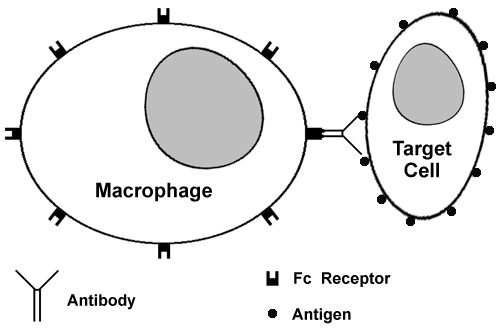
- An abnormal hypersensitivity response utilizing the ADCC mechanism is tissue allograft rejection., particularly in renal transplants.
- Case presentation: Anti-receptor Antibody Mediated Cellular Dysfunction
- History: A 35 year old previously healthy man has noted increasing weakness over the past couple of months. He works as a delivery man and drives a truck. He seems more tired and weak toward the end of the day. His muscles and his joints do not ache. A good night's sleep or a nap during the day does not seem to help much. He notices the weakness more with stop and go driving in the city or when a lot of boxes need to be moved off the truck. On physical examination, the weakness is more pronounced in proximal muscle groups such as quadriceps and biceps femoris. There does not appear to be significant muscle atrophy. Deep tendon reflexes are intact. There are no neurologic deficits.
- What do these findings suggest?
- The weakness seems to get worse with repetitive movement. The problem does not seem related to a neurologic problem.
- What tests would help to sort this out?
- Creatine kinase is elevated with degenerative processes. In his case, the CK is not elevated. Electromyography (EMG) can be performed to determine neuromuscular function. In his case, the EMG shows abnormalities of repetitive nerve stimulation of a nerve supplying a symptomatic muscle. There is a reproducible 10% decrement in amplitude when comparing the first stimulus to the fourth or fifth. Based upon these findings, a test measuring acetylycholine receptor antibody is performed and this antibody is found to be present.
- What disease does he have?
- Myasthenia gravis.
- Explain the pathophysiology of this disease.
- This form of type II hypersensitivity occurs when an autoantibody is produced against specific cell surface receptors. The autoantibodies block the receptors, producing cellular dysfunction.
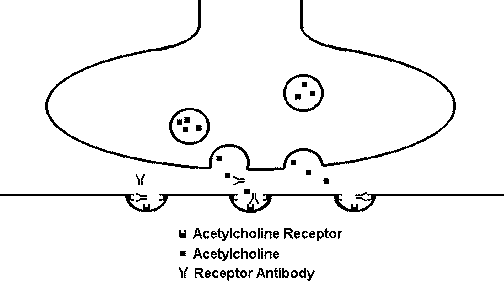
- The classic example is myasthenia gravis. In this disorder, an autoantibody is directed against acetylcholine receptors on striated muscle. The receptors are degraded and the lack of a normal depolarization of the muscle leads to muscular weakness, particularly with repetitive muscular use that depletes acetylcholine.
Thymic Hyperplasia
Thymoma
|
 Return to the Immunology Course Outline