


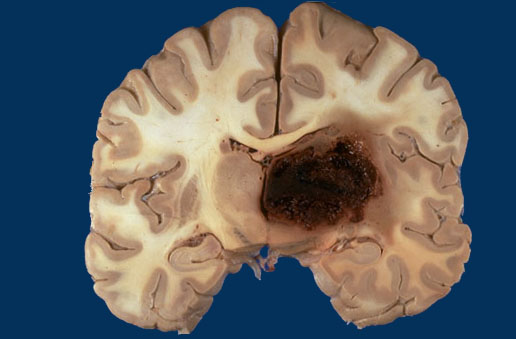
Correlation 5: Hypertensive HemorrhageThere is a large hemorrhage in the region of the basal ganglia. Persons with high blood pressure for many years are prone to develop intracerebral hemorrhage. The high blood pressure damages and weakens the small penetrating arteries, particularly in the region of the basal ganglia, especially the putamen. The sudden bursting of an artery leads to hemorrhage. The collection of blood produces a mass. There can be edema in the surrounding brain. This causes a mass effect with shift of the midline. A quickly expanding mass pushes the brain through any available opening, but since the brain is in an enclosed space, there is no way for it to expand without causing damage. The process of an organ pushing through an opening is called hernation. Areas of the brain that typically herniated include: the medial temporal lobe beneath the tentorium, the cingulate gyrus beneath the falx, and the cerebellar tonsils into the foramen magnum. A hypertensive hemorrhage is one form of "stroke" in which the patient can have a sudden change or loss of consciousness and loss of function. |
|
|
