Excavations at Kabri


Tel Kabri was discovered in the 1950s when members of Kibbutz Kabri found Late Neolithic stone implements on the surface near the ‘Ein Giah spring. At that time D. Alon and D. Rosoliyo of the Israel Department of Antiquities and Museums identified the Middle Bronze Age rampart and a tower on its northern stretch.

In the wake of these finds, a salvage excavation directed by M.W. Prausnitz was conducted near Dharat et-Tell (Area A) under the auspices of the Israel Department of Antiquities and Museums in 1957–1958. In 1961 the Mekorot Water Company incorporated the ‘Ein Shefa and ‘Ein Giah Springs into the National Water Carrier, cutting a 500 m trench about 4 m deep and 2.5 m wide across the site. The resulting cross-section was photographed and documented. In it, thick lime plaster floors were discerned, and it became clear that they belonged to a monumental building dating to the Middle Bronze Age. In future excavations it was established that these were the floors of a palace.

In 1969 MB IIA vessels probably originating from burials were discovered and their findspot (Area B) was excavated by Ben-Yosef, the regional inspector for the Department of Antiquities and Museums.
In 1975–1976, a brief rescue excavation was conducted by the Israel Department of Antiquities and Tel Aviv University, directed jointly by Prausnitz and Kempinski with the cooperation of Ruth Amiran of the Israel Museum. This project was aimed at investigating Area B, dating the rampart, and continuing the research into the Neolithic occupation at the site.

After several years of negotiations between Kibbutz Kabri and the Department of Antiquities and Museums, in 1986 an eight-year excavation project was begun by Tel Aviv University. It was directed throughout by Kempinski, with Eli Miron as deputy director until the 1988 season, and with Wolf-Dietrich Niemeier from then on. During these seasons the team partially uncovered the remains of both a Middle Bronze Age palace with Minoan-style fresco paintings and an Iron Age fortress at which Greek mercenaries were stationed. A full report of these seasons was published in 2002 (Kempinski 2002).
 

Periods Represented at Tel Kabri

The Late Neolithic Period
The Late Neolithic period (Wadi Raba culture) is well represented at the site by building remains, burials, stone axes, flint implements, and numerous sherds typical of Wadi Raba culture
.

The Early Bronze Age
The size of the Early Bronze Age I–II settlements was appreciable, extending over at least 30–32.5 acres in the north of the tell. Three strata dating to the Early Bronze yielded the stone foundations of several curvilinear and rectilinear buildings and four tombs of which three were jar burials.

The Middle Bronze Age
Although the site had already been settled in the Late Neolithic period, its apogee was, no doubt, during the Middle Bronze Age when a strong Canaanite ruler managed to recruit sufficient labor force and resources to construct a rampart that surrounded the city and build a palace of magnitude and artistic décor similar to those of the MB palaces of Syria.

The exact size of the settlement in the Middle Bronze Age IIA is not known, but judging from the location of the tombs in Area B, about 100 m away from the edge of the rampart, the excavations in Area D and from the finds in the Meqorot trench, it seems to have covered about 37.5-50 acres.

At the end of this phase the character of the settlement changed drastically. An area of 80 acres was surrounded by a rampart and city wall, and a palace—the first monumental building at the site— was erected in the northeastern part of the enclosed area. The early mound, which had risen above its surroundings in the north of the settlement, was now reduced to a slightly raised area, whose height above the edge of the settlement in some areas was only about 1.5 m. It seems that the city builders aimed at preparing large flat areas within the fortified boundary to facilitate planning the general architectural layout.

International trade played a great role in the development of the Middle Bronze II city at Kabri. It is possible that during the Middle Bronze Age IIA the city’s main commercial ties were with the Syro-Anatolian region. Following the breakdown of these ties as a result of the political and economic changes which took place in Anatolia at the end of the Old Assyrian Colony period (early 18th century BCE), commercial links began to develop with Cyprus. Kabri's links with Cyprus are emphasized by the abundant Cypriot finds.

The rapid expansion of Kabri in the first half of the 18th century BCE is undoubtedly associated with these foreign contacts. Kabri must have been the commercial and administrative center of at least the northern part of the Acre Valley in the Middle Bronze Age II, its port was possibly located either on the Ga’aton River in Nahariya or the Harbor at Akhziv
.

The Palace
The palace was a monumental structure that served as an administrative, religious, and economic center. It was built at the beginning of the MB IIB over a public building from the second half of the MB IIA (possibly an earlier palace), and reached its zenith in the second half of the MB IIB. It appears to have hadthree wings: The western and eastern wings with a staircase between them, together forming a central rectangular block and the southern wing built at a right-angle to the block. The palace included a complex of halls, rooms, and courtyards and extended over a vast area. Its carefully designed plan, the high quality of its construction and its painted walls and floors bear witness to its splendor. The staircase and the quantity of collapse debris indicate that the structure had more than one storey. Hall 611 and its antechamber, which served as the ceremonial section, comprised the heart of the palace,. Their thresholds were paved with flat stone slabs and floors ornamented with floral motifs and geometric designs executed in Aegean style and technique. Special ceramic finds testify to ceremonial activities that took place in this part of the palace. Judging from the domestic pottery found on the floors and in the debris, the eastern wing was apparently residential.. This is borne out by the loom weights and jars, which apparently fell from the upper floor. Hall 611 was planned and built with great care. It was probably roofed with cedar beams imported from Lebanon, since only such beams would have been long enough to span a hall as vast as this.

The meager architectural remains of the southern wing permit only a suggested reconstruction. It would appear to have served as the palace's cultic area, as suggested by distinctive elements found in and on the floors of its courtyards.


The Frescoes

The walls and floors of the palace were decorated with Aegean-style frescoes. The fresco technique was used in Crete as early as the 19th century BCE, but became known in the Levant only during the Hellenistic period.
The artists who decorated the palace at Kabri were familiar with the technique of fresco painting and the style and subjects in use in the Aegean islands. It may be assumed that they were brought from there to execute the work.

Similar wall paintings have been discovered at Alalakh and Mari in Syria and at Tell ed-Dab’a in Egypt.


The Floor
The floor of the Ceremonial Hall is extremely well preserved. The checkerboard design comprises a red lattice of about 600 squares, each 40 x 40 cm. In the center of the room is a colorful marble design surrounded by floral motifs such as lilies, pomegranates blossoms, and crocuses.


The Wall Paintings
The wall paintings survived only as small fragments of plaster. Wolf and Barbara Neimeier succeeded in reconstructing the portions displayed here from some of the 2300 painted fragments. The reconstruction is based on the great similarity to the frescoes from the West House at Akrotiri (Thera). The swallows in the sky, the flora, and the ships at sea prove that the origins of the panting at Kabri lay in the Aegean world.


The Fortifications
The remains of the fortification system surrounding the MB city were clearly discernable even before the excavation began. A broad flat rampart ca. 35 m wide rose between 6–8 m above ground level. Huge, partially-dressed stones were scattered over its slopes. A trial excavation conducted in 1975 enabled the determination of the rampart’s structure, size, and date. The rampart was constructed of two large walls that retained a ca. 8 m thick massive core comprising mud and pebbles.

Burials

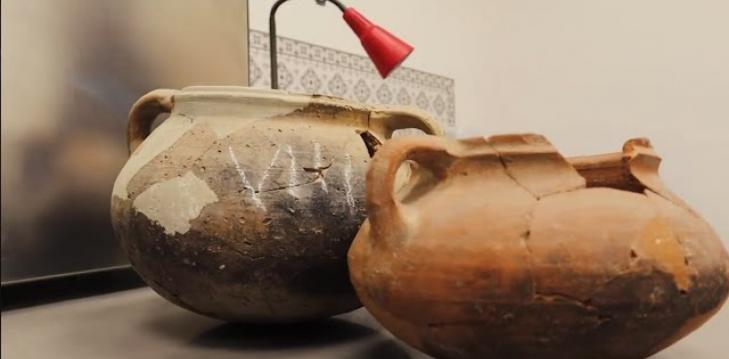
Four Early Bronze tombs were found under floors, three of which were jar burials of children and infants—a common form of burial in Early Bronze Canaan. Fifteen burials dating to the MB were found in Kabri: In area C three jar burials and three pit burials were uncovered underneath floors of houses and courtyards, with a variety of jewelry and pottery, as well as three masonry-built tombs. Among them, the well-constructed Tomb 498 was the richest in finds. It was full of skeletal material and burial offerings covered its entire floor. In all it contained 339 vessels, including 240 juglets, three alabaster vessels, 14 scarabs, faience and haematite bead[s???], and toggle pins. This assemblage demonstrates that the tomb had been in use over a long period of time. Four pit burials and two masonry-built tombs from the MB were found in area B. Among the rich burial offerings were many ceramic finds including imported Cypriot vessels, toggle pins, scarabs, and beads, as well as a bronze dagger and two stamp seals.


The Late Bronze Age


The Late Bronze Age is represented in area E by isolated sherds found in the debris below the lowest Iron Age floors. Yet no appreciable Late Bronze Age settlement was discerned at Kabri, which was apparently abandoned at the end of the Middle Bronze Age when the inhabitants scattered to other settleme
nts.

The Iron Age


The Iron Age settlement was concentrated in the southern half of the site, covering ca. 4.5–5 acres in Areas E and D. In the 10th century BCE a fortress was constructed on et-Tell and strengthened during the course of the Iron Age II.


The Persian and Hellenistic Periods


Th
e only evidence of Persian period settlement is provided by several mortaria sherds. The Hellenistic period is evidenced by an Aqueduct, the remains from a tomb dated to the 2nd century BCE, found on the northern slope of et-Tell, and a Phoenician seal impression bearing a date of 119 according to the Tyrian era. These finds indicate that Kabri was an important village in this period. It is likely that the region of Kabri, with its valuable springs, belonged to the Hellenistic city-state of Acre-Ptolemais.