Dynamic morphological patterns in linguistic acquisition: Graph theory
Elitzur Dattner1,2, Ronit Levie2, Orit Ashkenazi2, and Dorit Ravid2
1Bar-Ilan Unviersity, 2Tel Aviv Unviersity
Child Language Symposium 2019 | University of Sheffield, July 12, 2019
Introduction
The Hebrew verb
-
Verb lemma = root+pattern (binyan) non-linear formation
-
The prototypical habitat of Hebrew non-linear morphology
-
The earliest derivational system to be acquired in Hebrew
Berman, 1993, 2012; Bolozky, 1996, 2007; Ravid, 2012, in press; Schwarzwald, 2002
The Hebrew verb
-
Root k-t-b + verb pattern (binyan) Hitpa’el = hitkatev 'correspond'
-
ALL Hebrew verbs are based on combination of about 1,500 roots and seven binyan verb conjugations
Berman, 1993, 2012; Bolozky, 1996, 2007; Ravid, 2012, in press; Schwarzwald, 2002
Hebrew verb morphology: a network perspective
• A form-form network
• Connecting roots and patterns (Levie et al., in press; Ravid et al., 2016)
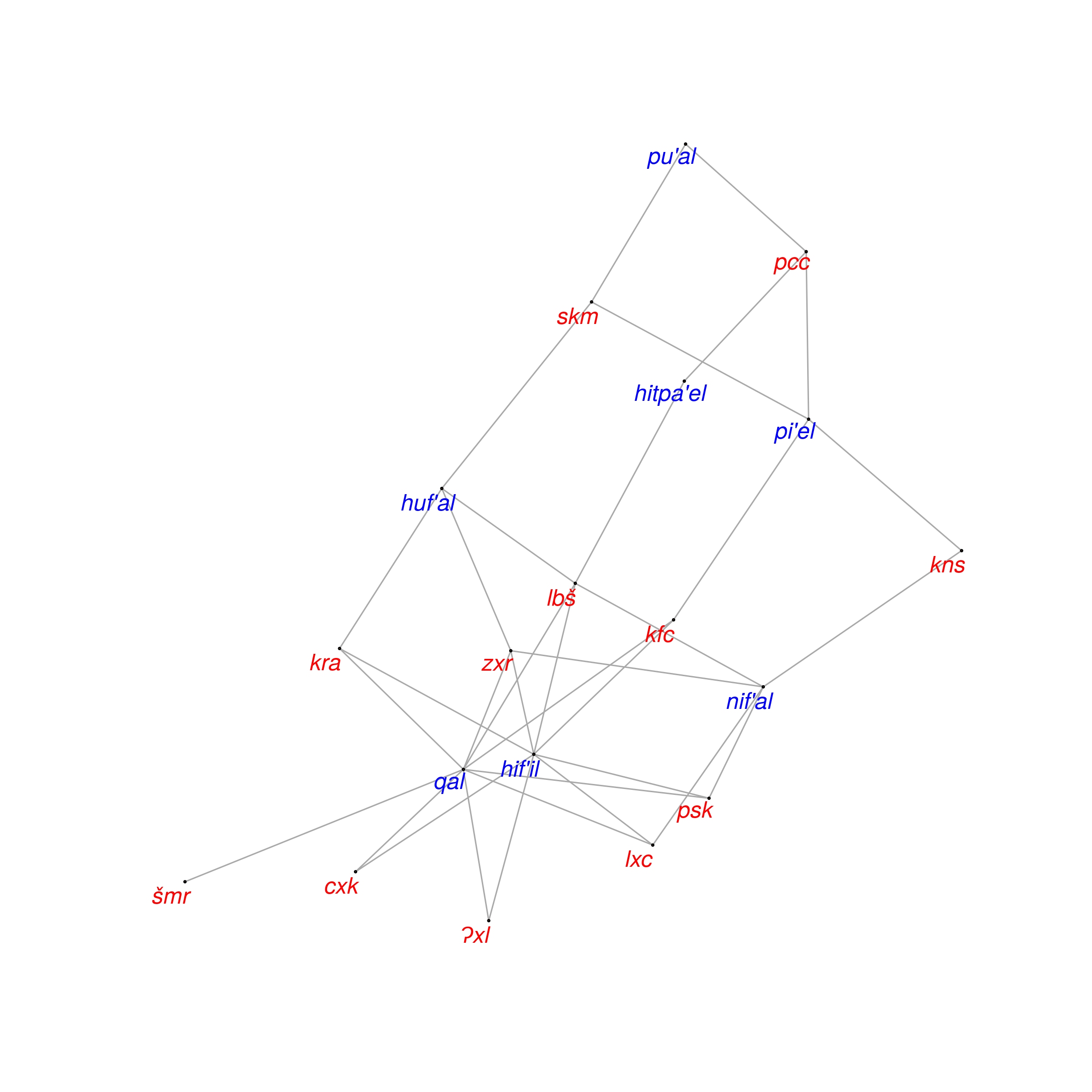
Roots
• The root is Hebrew's main lexical prime, containing 3-4 radicals
• Constitutes the formal and lexical core of the Semitic lemma
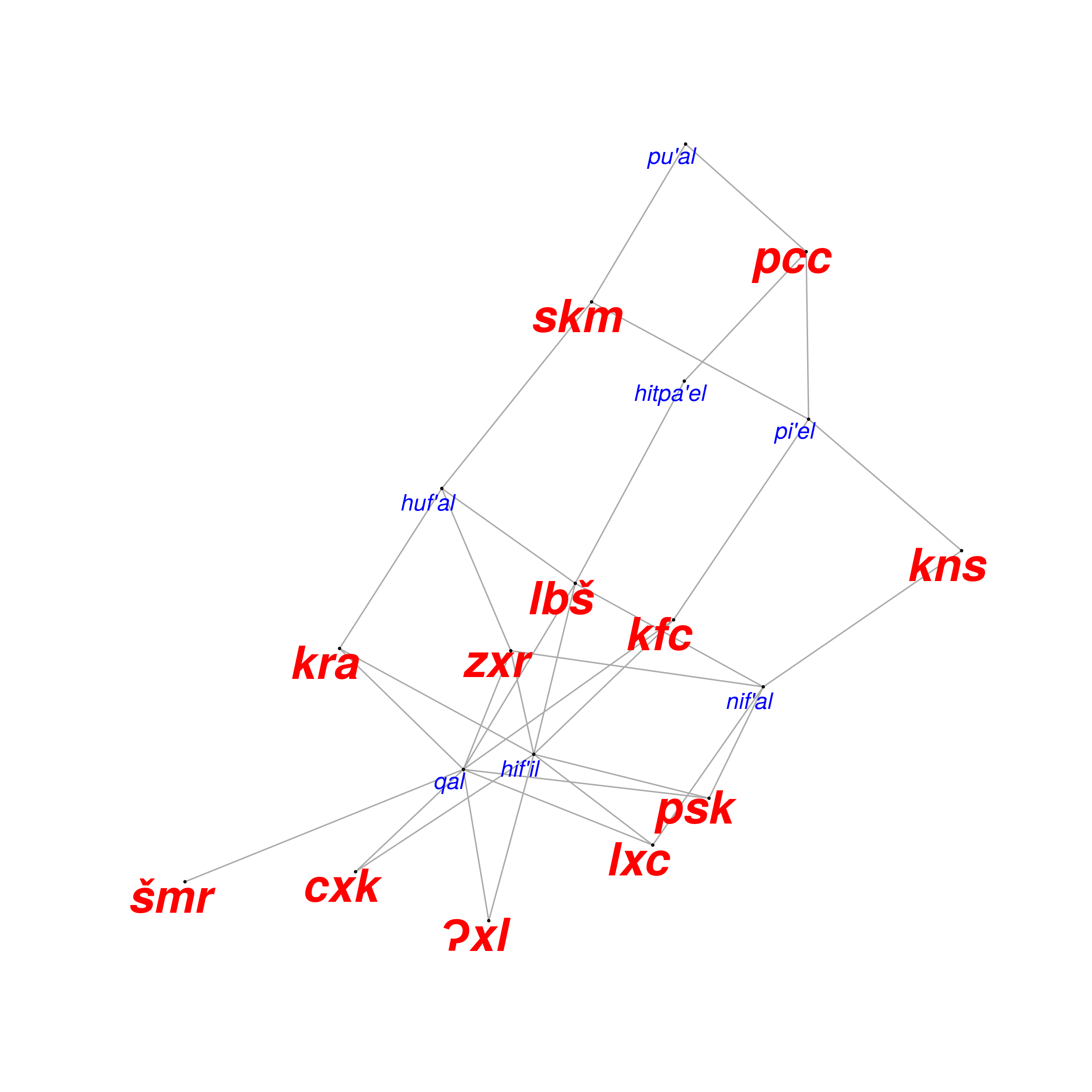
Roots form root-based families:
• lxc+qal = 'press'; lxc+hif'il = 'make someone stressed', lxc+nif'al = 'get stressed'
• pcc+pi'el = 'bomb'; pcc+hitpa'el = 'blow up', pcc+pu'al = 'got blown up'

Patterns
• Each pattern provides a unique paradigm of five non-linear temporal patterns
• Each temporal pattern is a unique vocalic (morpho-phonologic) template
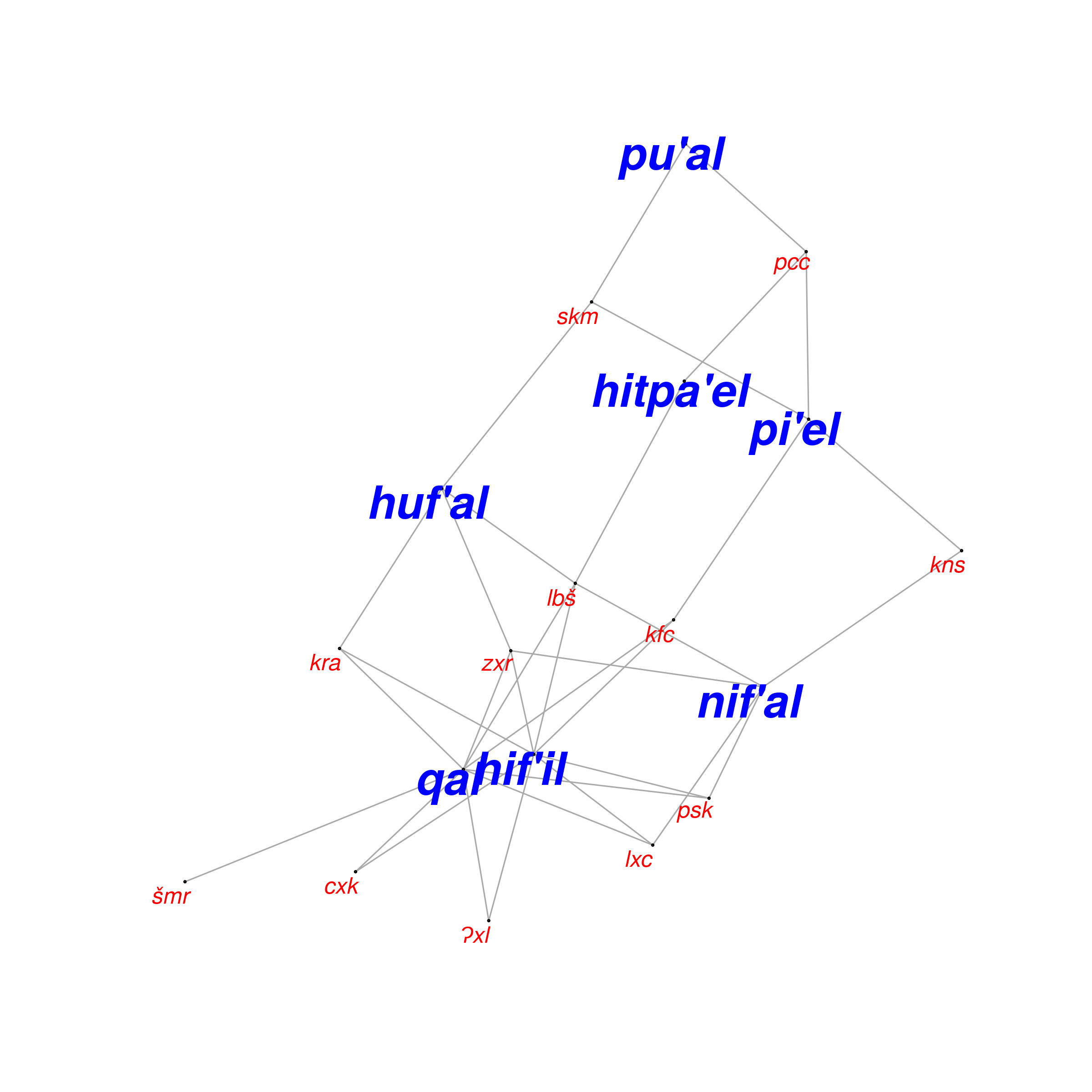
Patterns
• The pattern (binyan) system is composed of seven types
• A pattern classifies verbs by transitivity related syntactico-semantic functions (causativity, inchoativity, reciprocity, reflexivity, middle voice, passive voice)
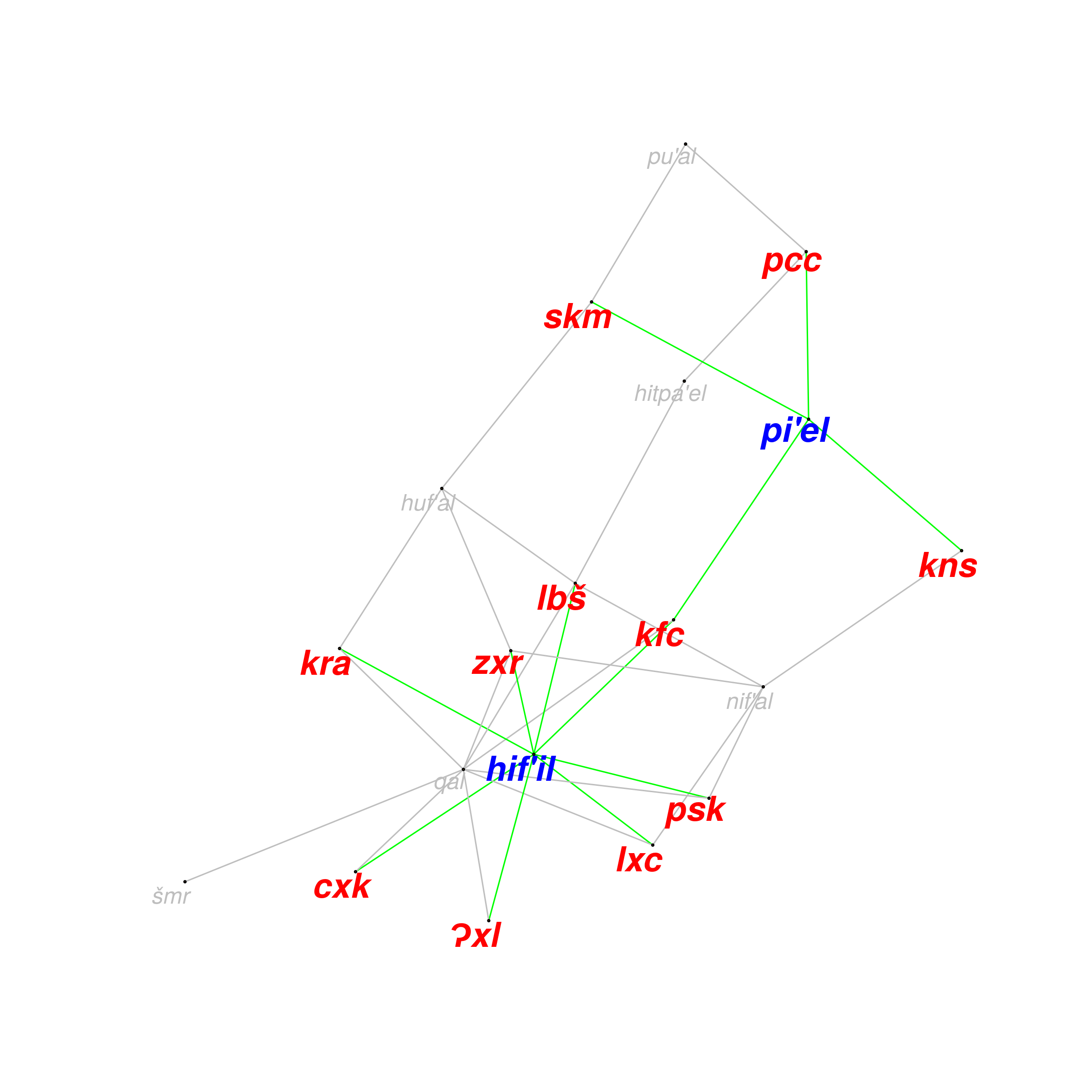
Patterns form pattern-based families:
• Ɂxl 'eat', cxk 'laugh', lxc 'stressed someone', psk 'stop (tr.)', zxr 'recall (tr.)', kfc 'jump (tr.)', lbš 'dress (tr.)', kra 'read (tr.)' are related by the hif'il pattern
• skm 'summarize', pcc 'blow up (tr.)', kns 'gather' are related by the pi'el pattern
Two subsystems
Old vs. New
• Each sub-system is a set of mutually exclusive patterns (old: 4; new: 3)
• Each sub-system fully expresses all verb functions and all transitivity values (basic, causative, middle, inchoative, reflexive, reciprocal, passive) (Ravid et al., 2016)

Two subsystems
Old vs. New
• Semi-productive dual system: serves as a highly efficient platform for expanding the verb lexicon across development
Two subsystems
Old vs. New
• Critical interface with syntax: strongly linked to verb argument structure (Ashkenazi et al., in press; Dattner, 2015; Ravid, in press)

Network analysis: rational
• Network analysis is an effective way of studying complex and distributed systems (Bell et al., 2017; Kolaczyk, 2009)
• The development of dynamic systems with growing complexity is at the heart of language acquisition (Vitevitch & Goldstein, 2014)
• Language development is dynamic, entailing growing complexity of networks (Beckage, Smith, & Hills, 2011; Levie et al., In press; Salmon, Dattner & Ravid, 2018; Steyvers, & Tenenbaum, 2004)
Network analysis: rational
• The mental lexicon is often metaphorically described as a network (e.g., Elman, 2004; Kenett et al., 2011)
• A metaphor that mostly characterizes the interconnected nature of the semantic relations between words
• Here we show that this metaphor captures the interconnected nature of the morphological relations within the verb lexicon as well
Data and method
Data
10 sub-corpora; CS and CDS; 500 tokens sample each
Child speech
CS: two mother-toddler dyads - a boy and a girl, 1;8-2;2
Dense recordings (three times a week, one hour each time) over a period of six months; mid-high SES, typical development. Total corpus: 7,706 verb tokens (72,086 words)
Peer talk: conversations of six age groups: 2;0-2;6, 2;6-3;0, 3;0-4;0, 4;0-5;0, 5;0-6;0, 7;0-8;0
30-minute recordings of triads of same-age children in spontaneous play. Native Hebrew speakers, typical development, mid-high SES. Total corpus: 6,073 verb tokens (32,981 words)
Data
10 sub-corpora; CS and CDS; 500 tokens sample each
Child (infant) directed speech
IDS: one dyad of mother-baby girl, 6, 9, 12 months (a total of 3 hours)
Mid-high SES. Total corpus: 1,109 verb tokens (4,908 words)
CDS: two mother-toddler dyads - a boy and a girl, 1;8-2;2
Dense recordings (three times a week, one hour each time) over a period of six months; mid-high SES, typical development. Total corpus: 54,810 verb tokens (299,461 words)
Children's books: 140 children books
100 Children’s storybooks, age 1-7; 40 novice readers books (first and second grades): Texts written by experts. Total corpus: 10,943 verb tokens (49,348 words)
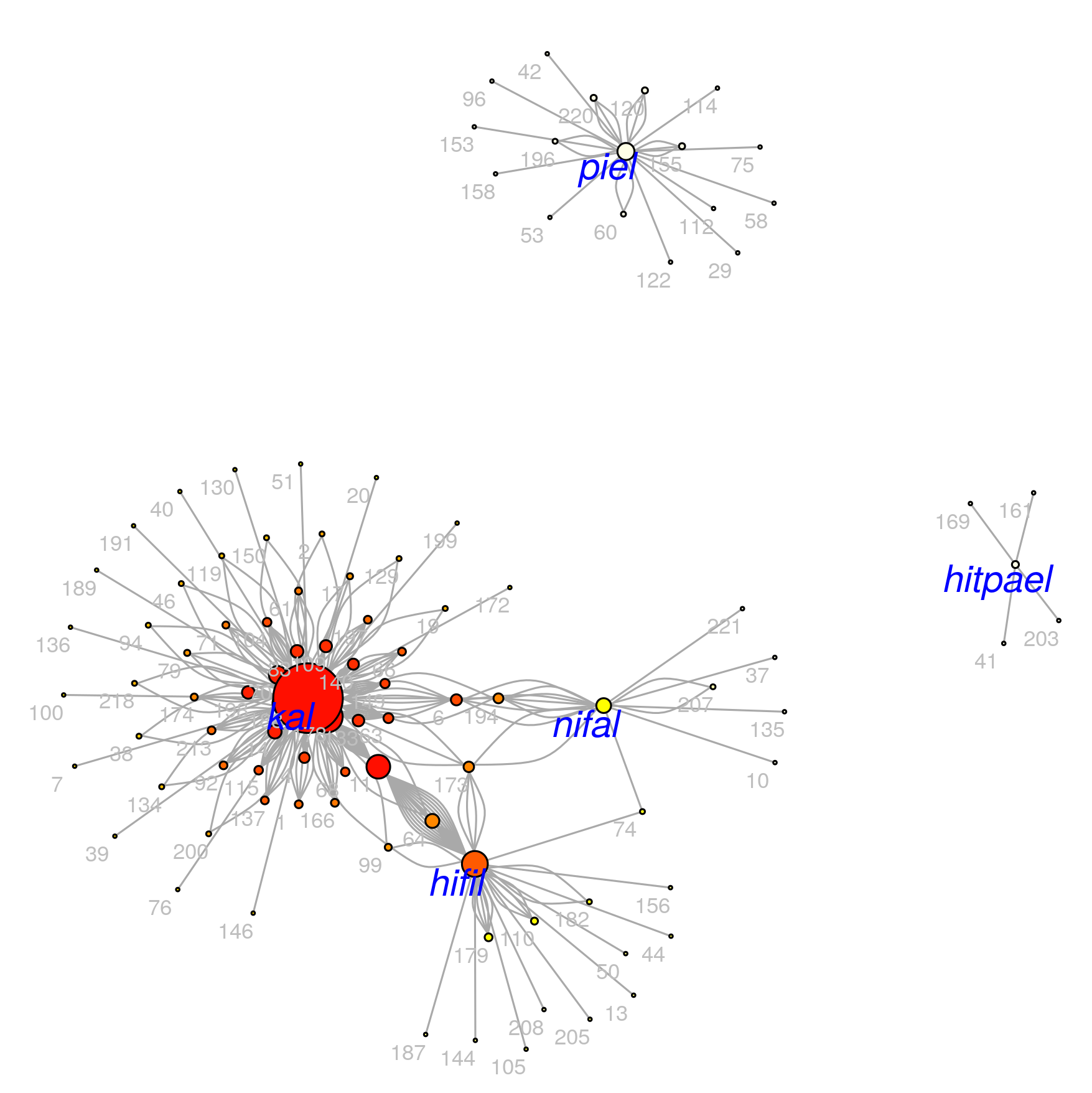
Network structure
-
Nodes
Roots and patterns -
Links
Verb lemmas (repeated links = repeated tokens) -
Node size and color
Frequency and centrality →
Node centrality
-
Measure
Nodes that are connected to many other nodes that are connected to many others, etc... -
Importance
High centrality nodes are busy hubs (red color) -
Hypotheses
Specific nodes' centrality would change through development
Network density
-
Measure
Proportion of observed links relative to the maximum number of possible links -
Growth potential
Low density = high growth potential: The potential to form new links between roots and patterns -
Hypotheses
A low density network has more room to grow: more possible new links between roots and patterns (Levie et al., in press)
Results
Child Speech, 1;8-2;2
• No links between the sub-systems
• Old system productive; new system less so
• Many repeated links
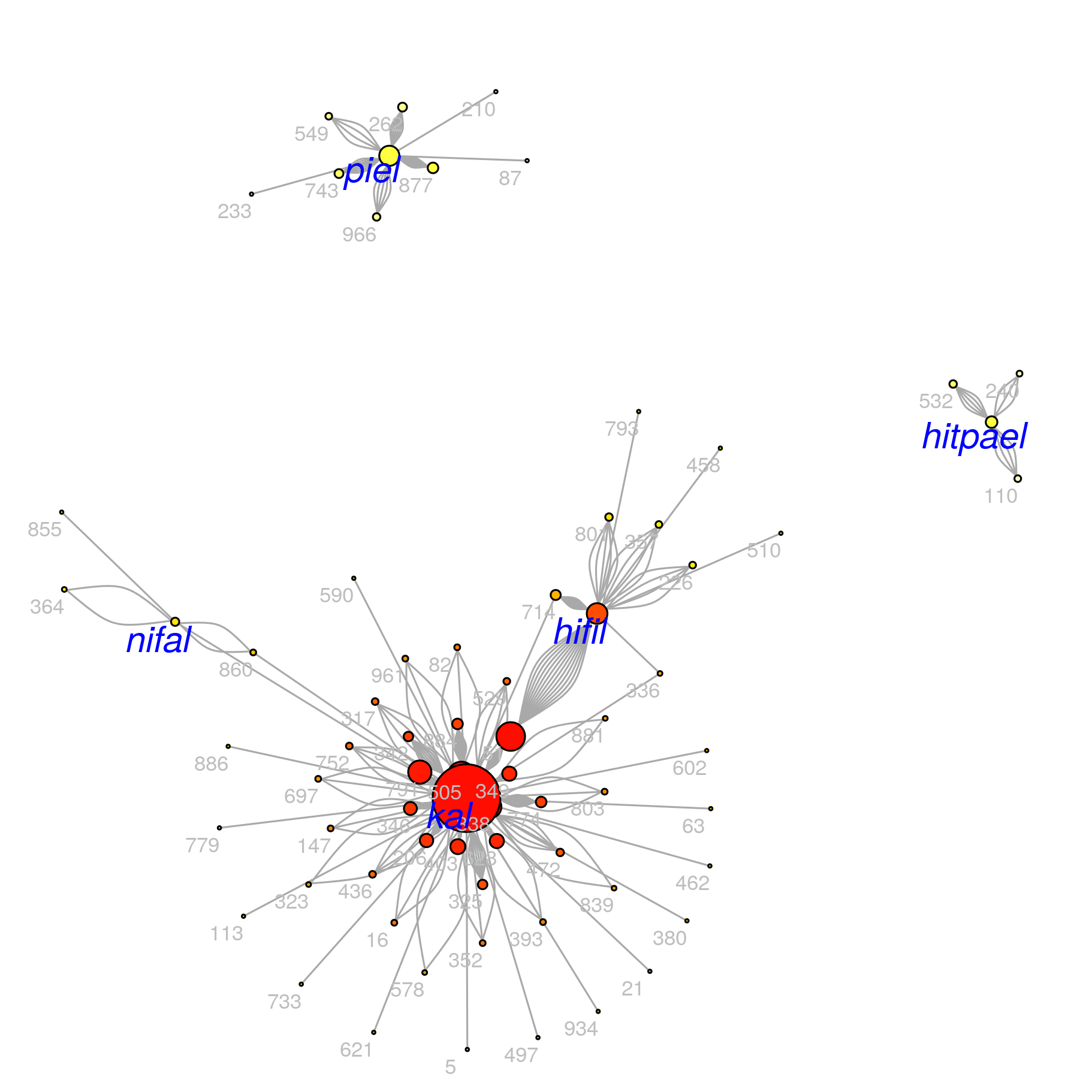
Peer Talk, 2;0-2;6
• No links between the sub-systems
• Old system productive; new system gains centrality
• Many repeated links
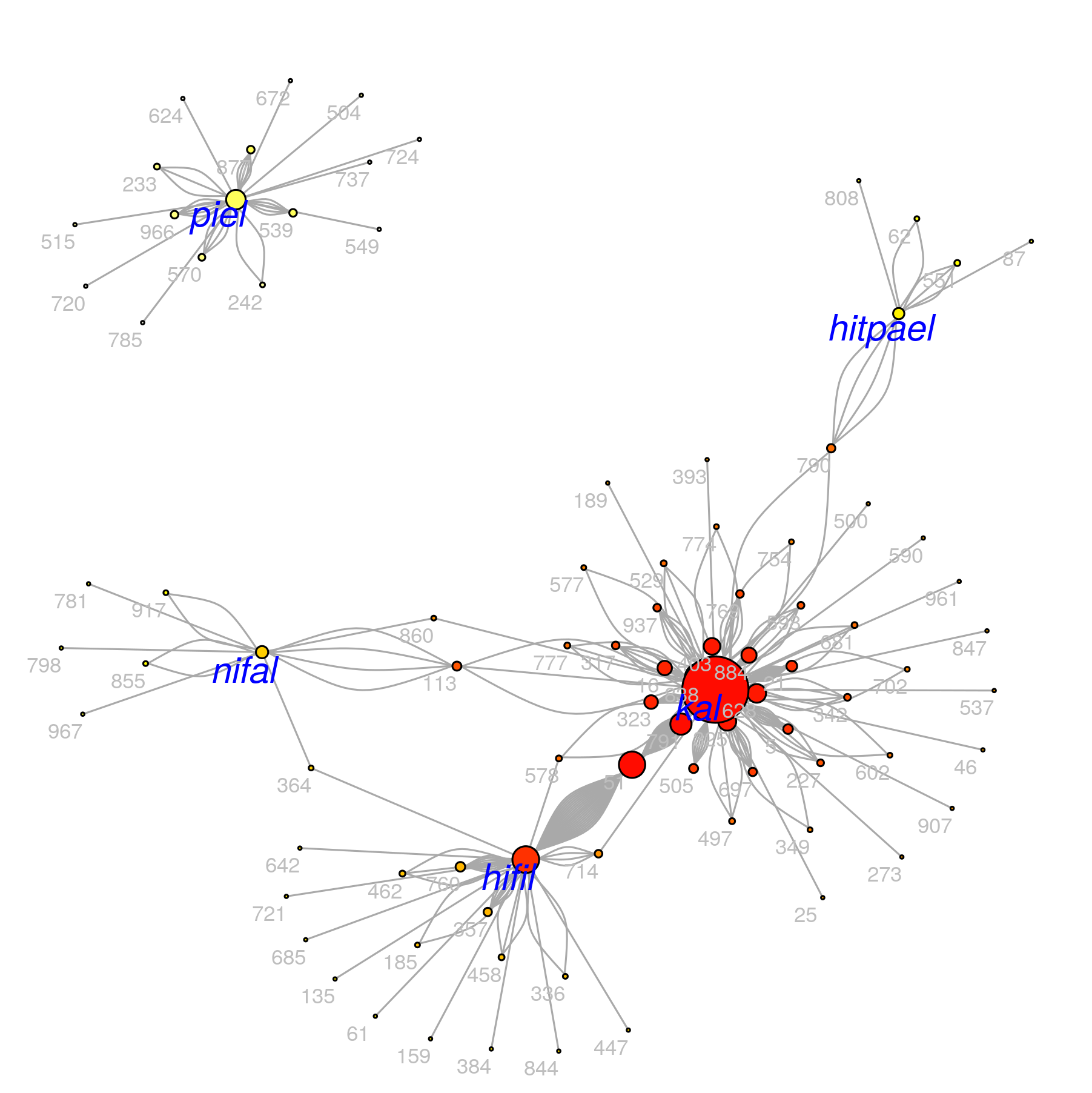
Peer Talk, 2;6-3;0
• Links between the sub-systems
• Old system productive; new system gains more centrality
• Many repeated links; more single tokens
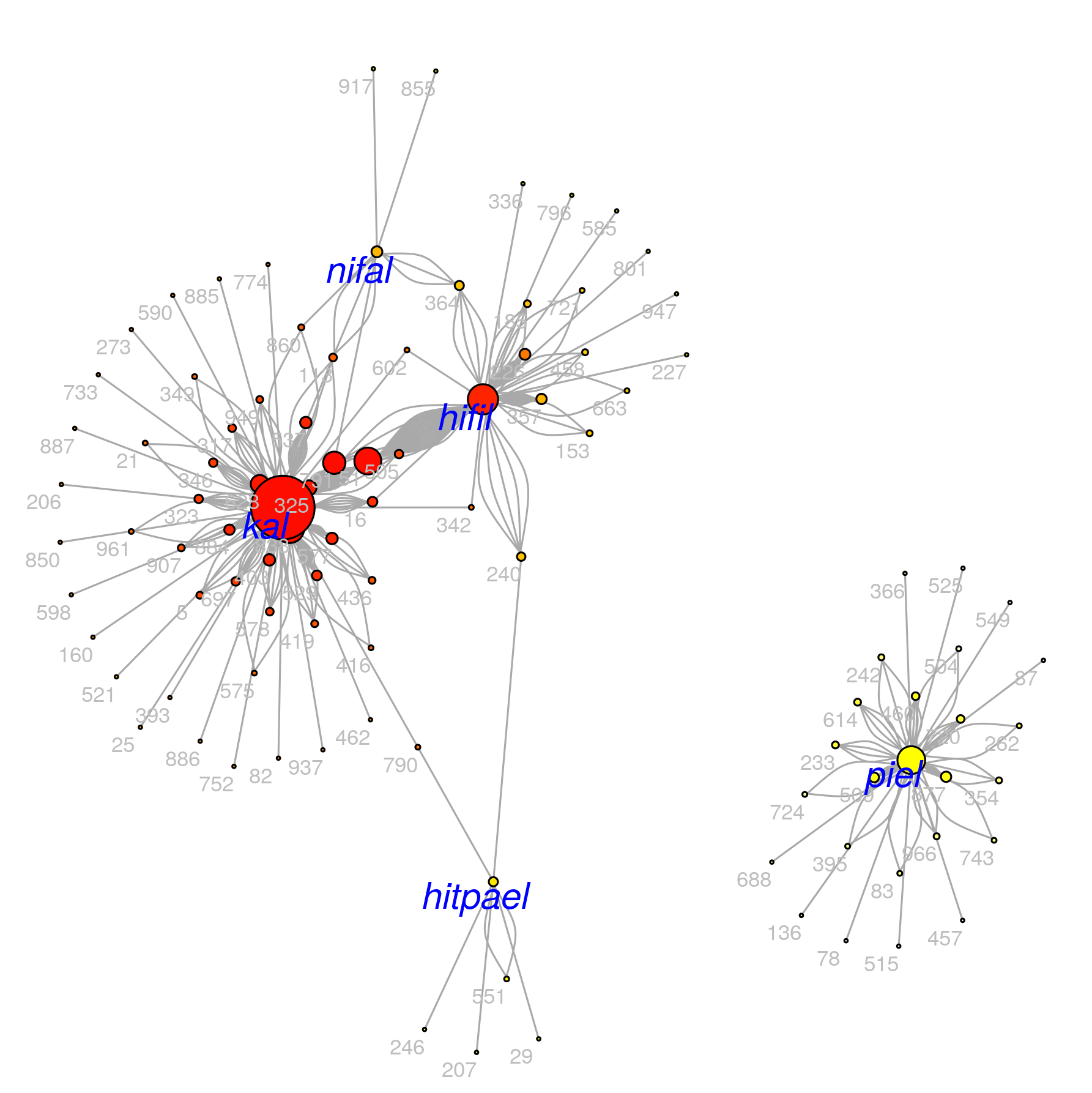
Peer Talk, 3;0-4;0
• More links between the sub-systems
• Old system productive; new system gains more centrality
• Many repeated links; more single tokens
Peer Talk, 4;0-5;0
• Links between the sub-systems
• Links within the new system
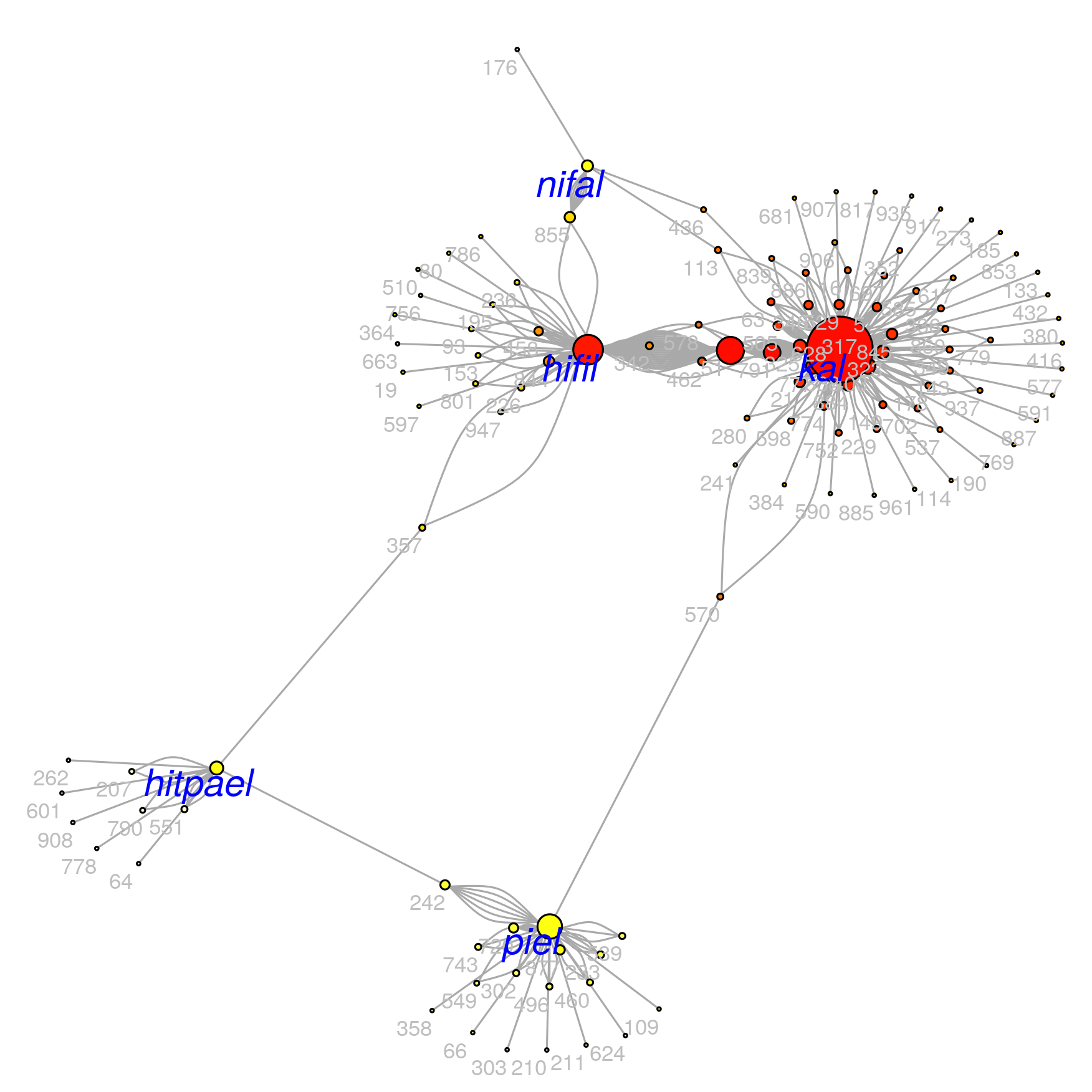
Peer Talk, 5;0-6;0
• More links between the sub-systems
• Links within the new system
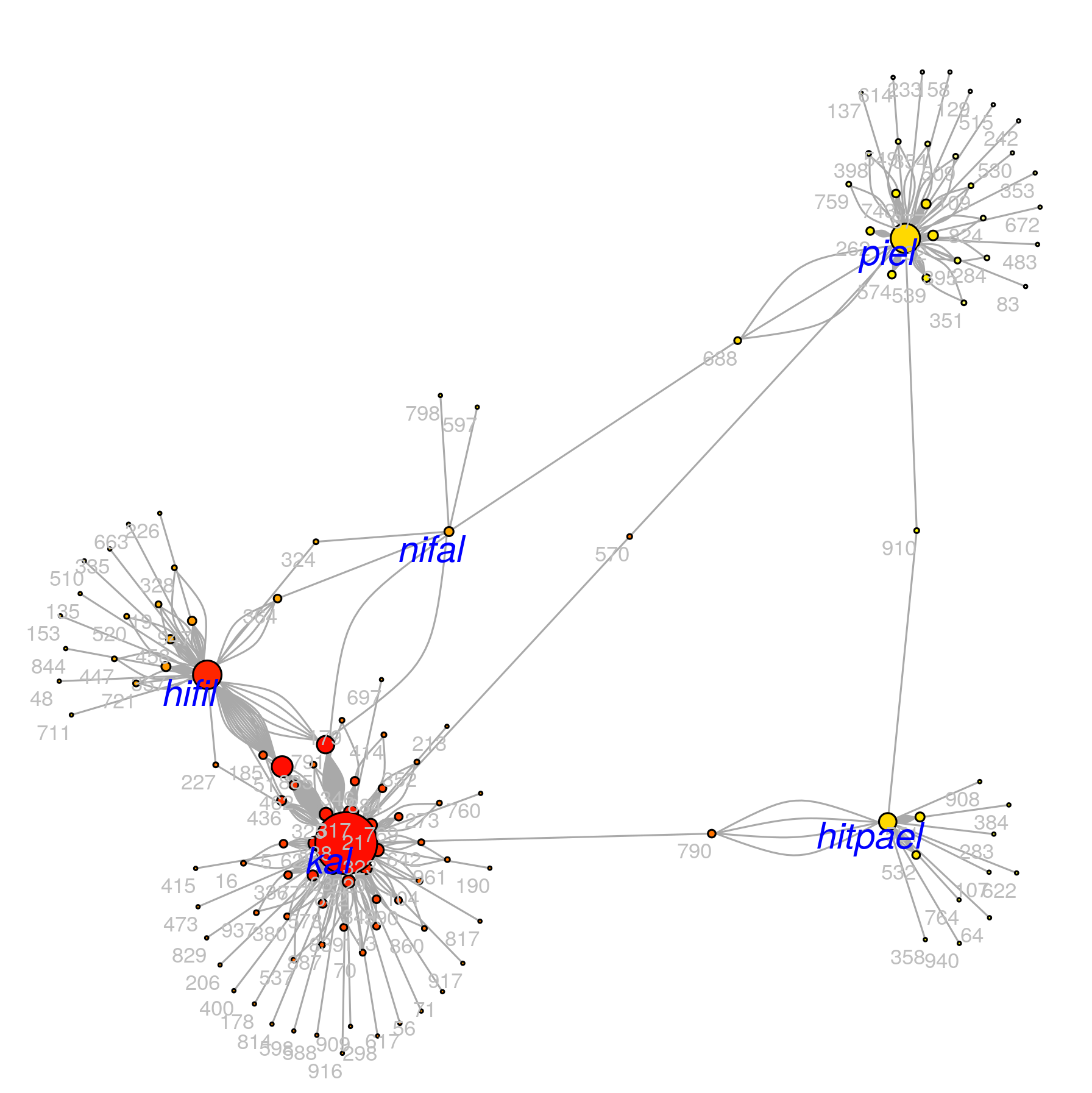
Peer Talk, 7;0-8;0
• Links between the sub-systems
• nif'al gains centrality
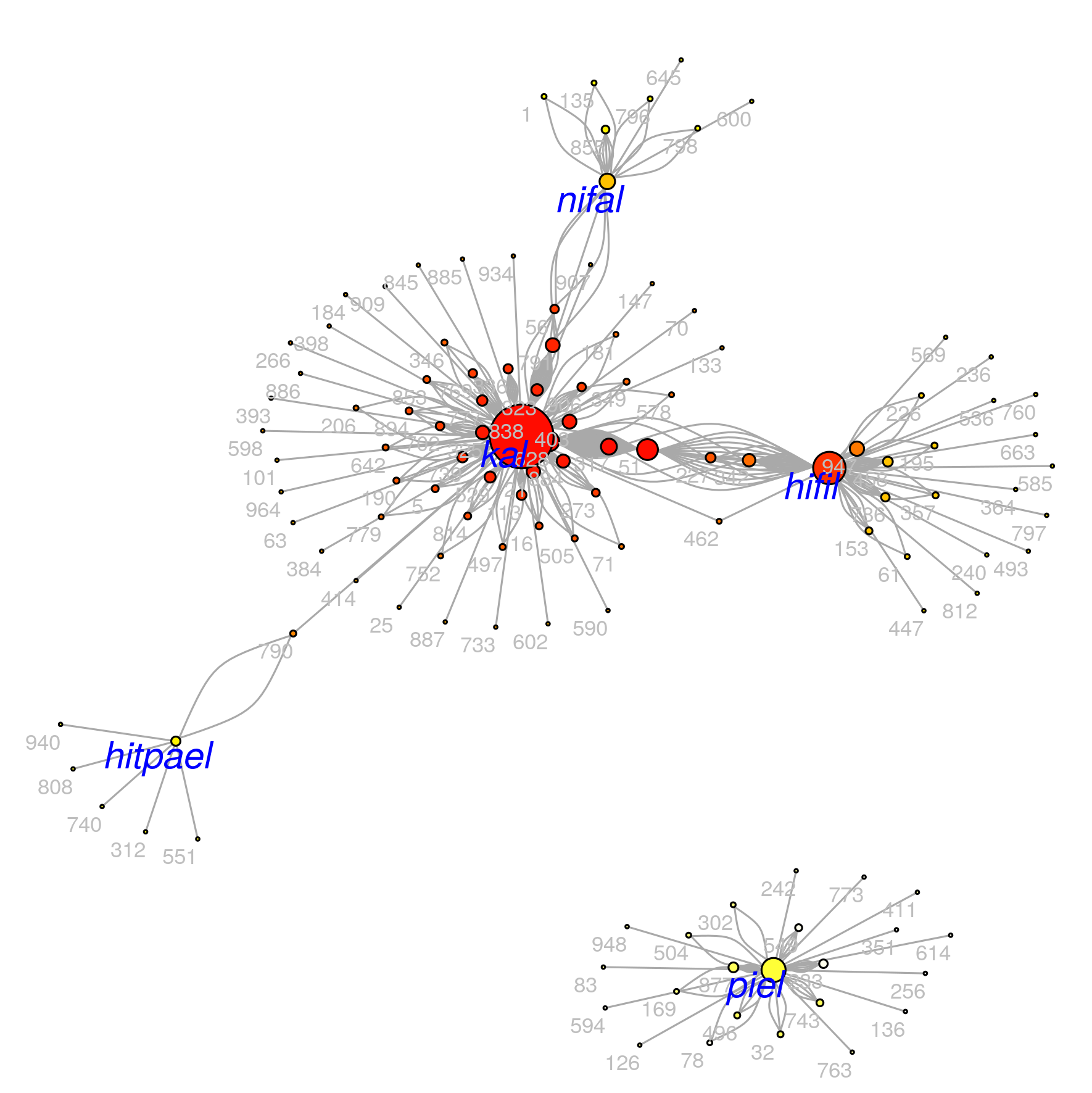
IDS, 0;6-1;0
• Links between the sub-systems
• Links within the new system
• Old system productive; new system too, but less
• Passive pattern pu'al
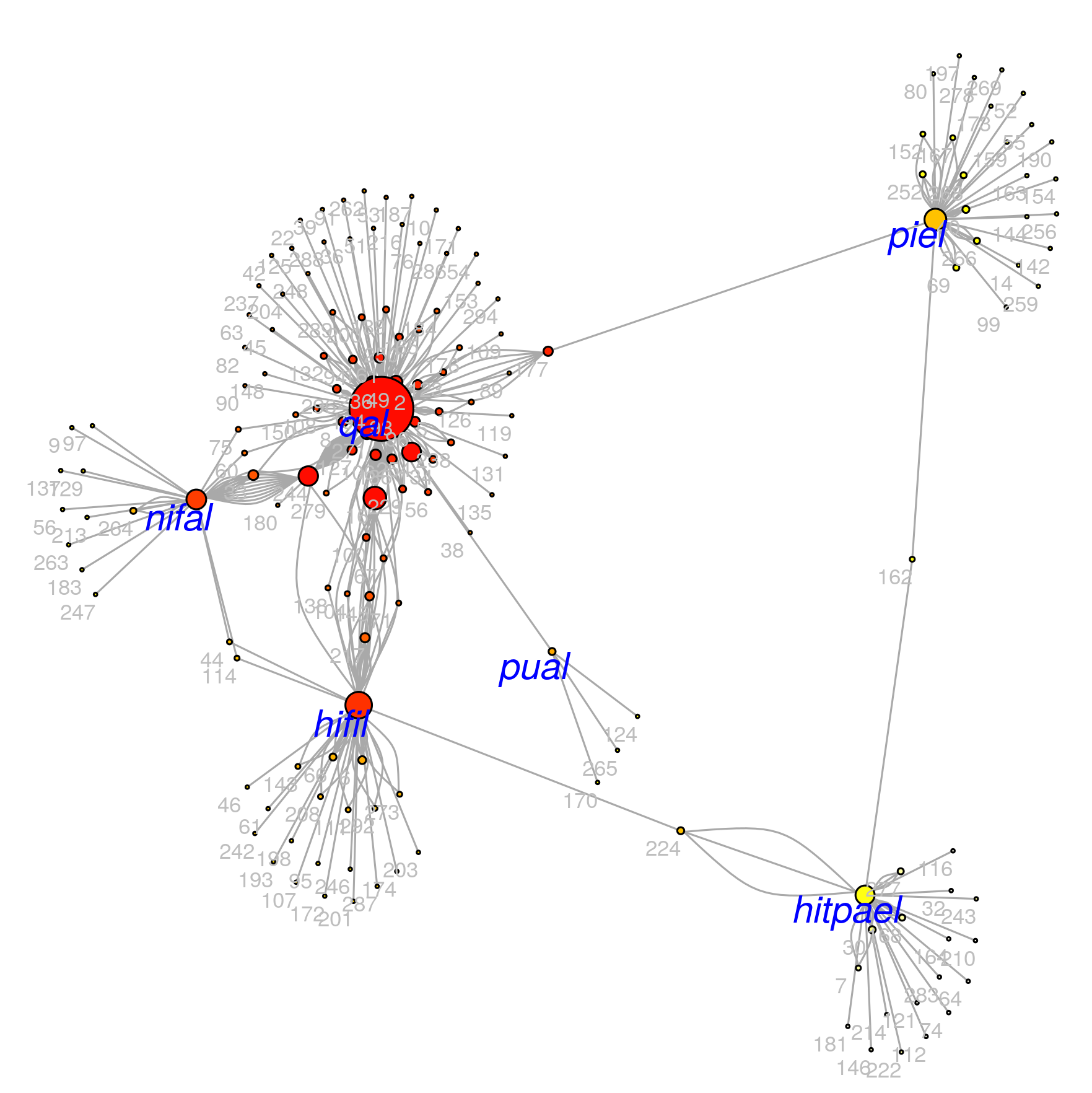
CDS, 1;8-2;2
• Links between the sub-systems
• nif'al gains centrality
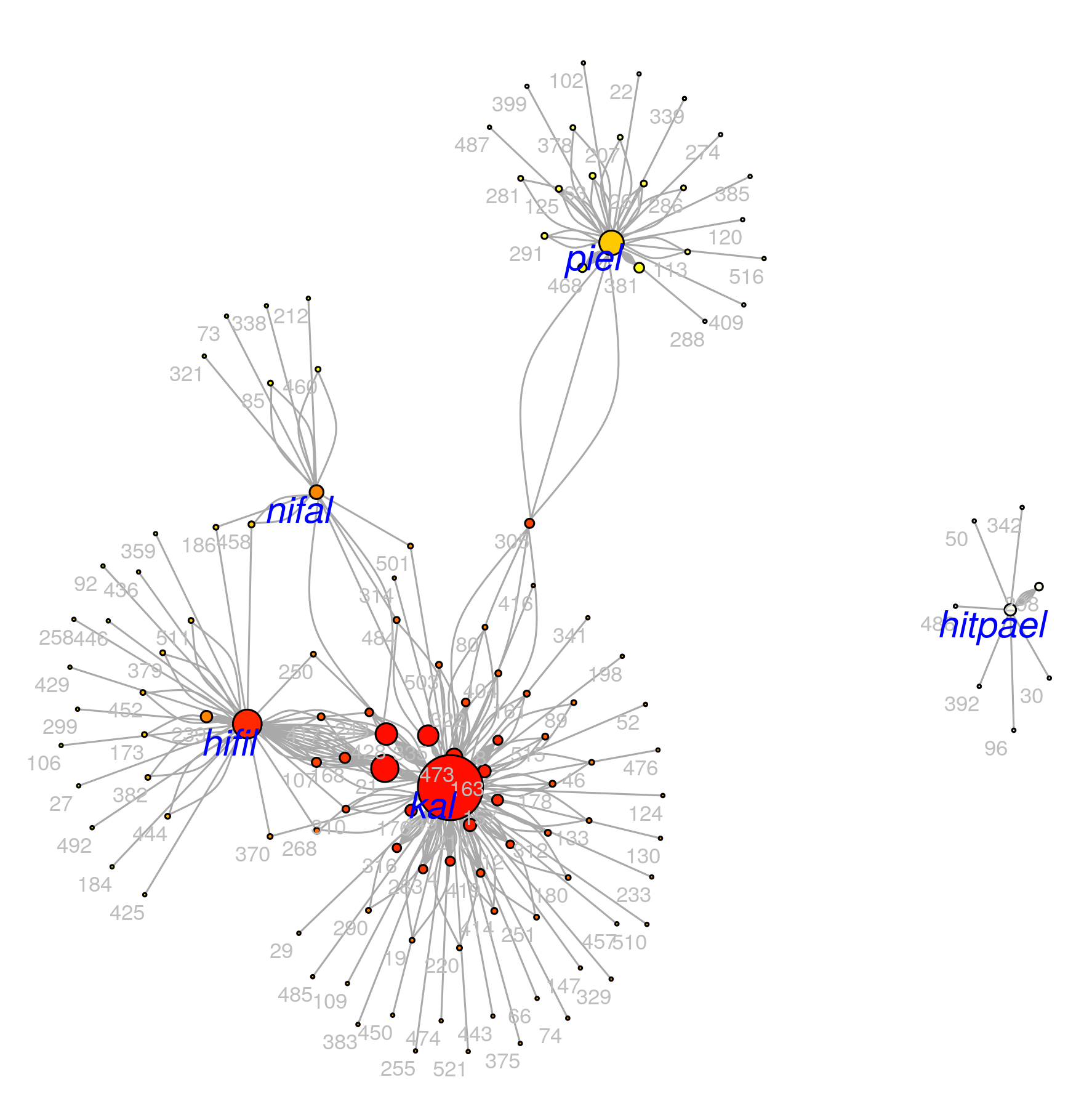
Children's books
• Many links between the sub-systems
• Many links within the new system
• nif'al gains centrality
• Passive pattern huf'al
• Fewer recurrent links
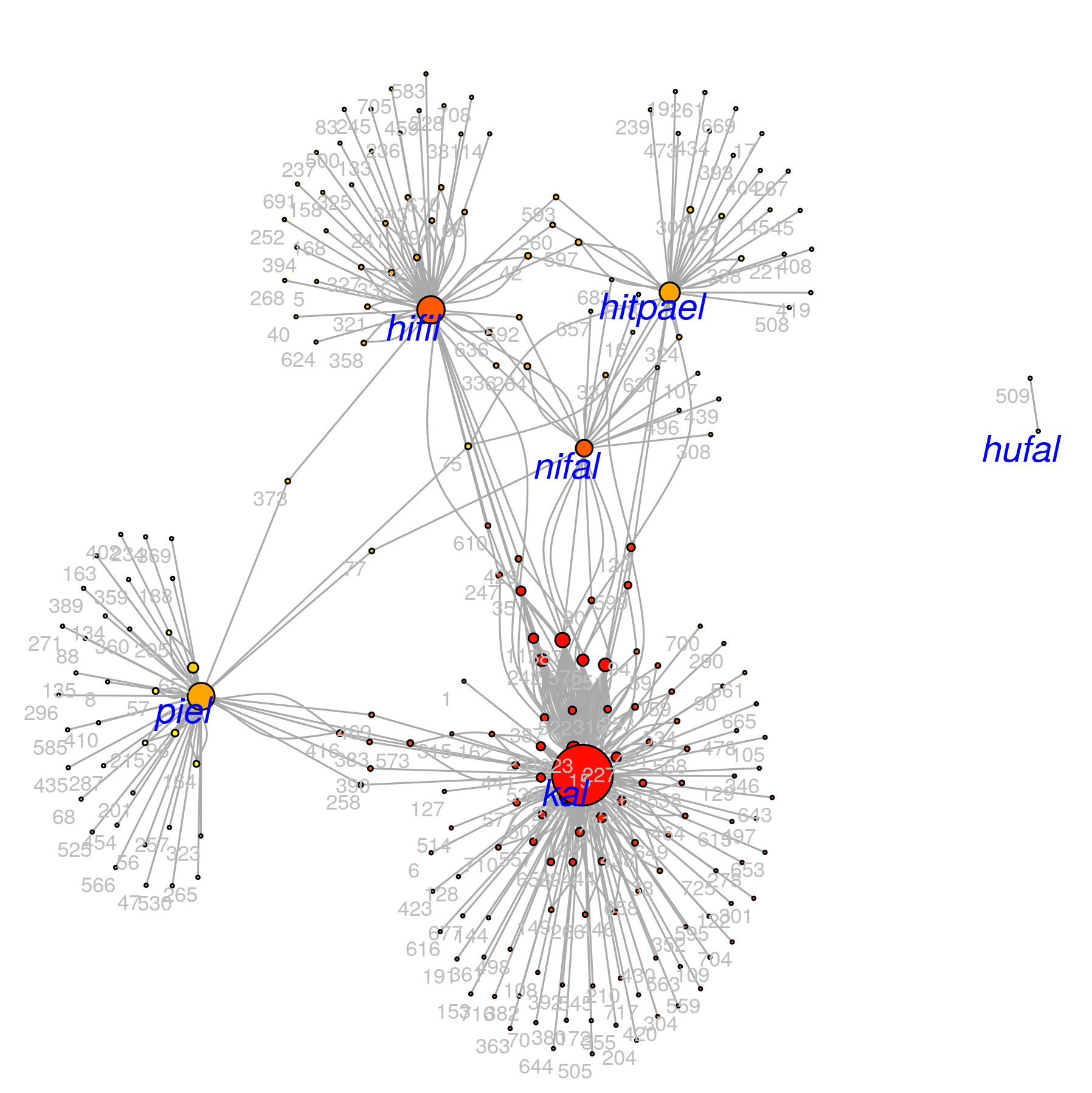
Reminder: node centrality
-
Measure
Nodes that are connected to many other nodes that are connected to many others, etc... -
Importance
High centrality nodes are busy hubs (red color) -
Hypotheses
Specific nodes' centrality would change through development
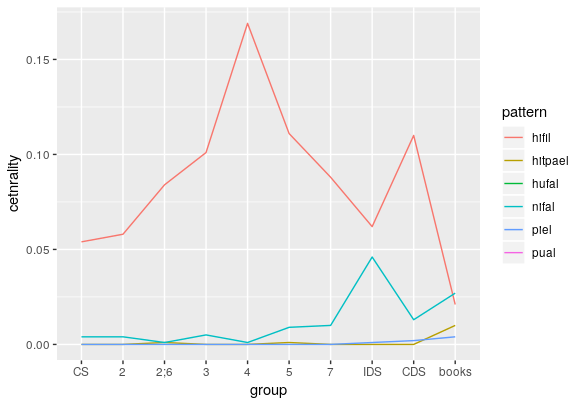
The centrality values of the patterns hif'il and pi'el change through development. Other patterns remain steady: either very low, or very high as in the case of qal which is not represented here
Trade off: as pi'el gains importance in the network, the role of hif'il becomes less prominent
Reminder: network density
-
Measure
Proportion of observed links relative to the maximum number of possible links -
Growth potential
Low density = high growth potential: The potential to form new links between roots and patterns -
Hypotheses
A low density network has more room to grow: more possible new links between roots and patterns (Levie et al., in press)
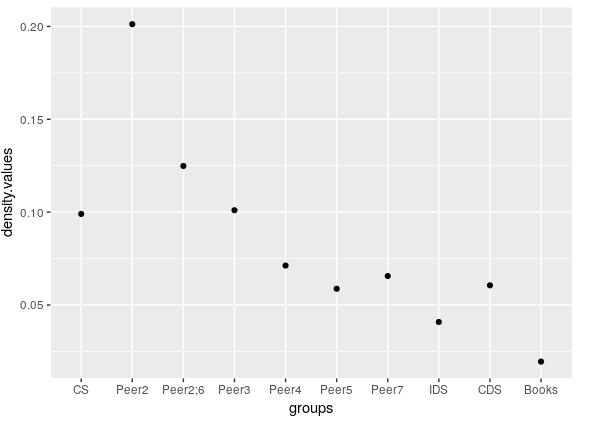
Density significantly declines with age (X2=2512, p<0.001)
CS, 2;0-5;0, 7;0-8;0 > expected; 5;0-6;0, CDS = expected; IDS, children books < expected
Conclusions
1
Node centrality changes with age
The verb lexicon is dynamic through development: patterns play different roles in each stage. Competing patterns' roles interact
2