Case Presentation:
- History: A 5 year old child has had a cough with fever for the past two days. The child has stopped eating and stays in bed. The child is taken to the family physician, who finds vital signs of T 38.0 C, P 86, RR 18, and BP 90/60 mm Hg. On auscultation of the lungs, there are basilar crackles bilaterally. A chest radiograph is ordered and shows patchy bilateral infiltrates. A CBC is ordered and shows Hgb 14.2 g/dL, Hct 42.9%, MCV 97 fL, platelet count 249,000/microliter, and WBC count 13,770/microliter with differential count 77 segs, 7 bands, 11 lymphs, 4 monos, and 1 eosinophil. A sputum sample and nasopharyngeal swab are obtained. The sputum gram stain shows short gram negative rods. Hemophilus influenzae is cultured and subtyped as type b.
- What cellular immune response is occuring?
- This is a humoral immune response with Hemophilus influenzae pneumonia.
- What serum chemistry findings could be predicted?
- Elevations in acute phase proteins such as CRP, elevations in complement, and increased gamma globulins.
- Describe the production of antibodies:
- B lymphocytes are in charge of antibody production. Antibodies are made of globular proteins called immunoglobulins that are secreted by B cells.
- An immunoglobulin molecule is Y-shaped and has two identical light chains and two identical heavy chains that attach by disulfide bonds. The two heavy chains are attached, and a light chain attaches to the end of each heavy chain. Each chain has domains that are either constant or variable. Each light chain has one variable (VL) and one constant (CL) domain. Each heavy chain has one variable domain (VH) and three or four constant domains (CH). The variable domains at the ends of the “Y”, the Fab portions, determine the specificity of the antibody for an antigen. The constant domains at the base of the “Y” form the Fc portion.
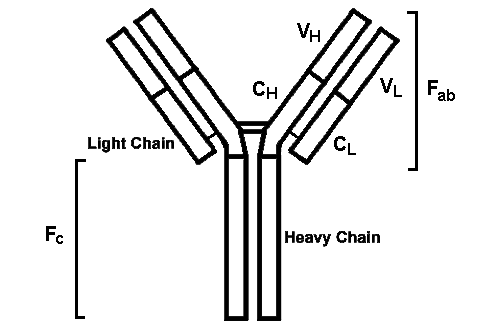
- The part of the antigen recognized by the variable domains is called an epitope, or a determinant. The more tightly the antibody binds to an antigen, the more affinity it has, and this tends to increase as more antibody is produced. A particular clone of B cells produces an antibody with one specificity for a particular antigen.
- Immunoglobulins are divided into classes, based upon the type of heavy chain present. The classes are IgA, IgM, IgG, IgE, and IgD. Two classes of light chains can be present on any heavy chain and are either kappa or lambda light chains. Classes of antibody are also known as isotypes. In addition, there are four subclasses of IgG. IgD is not secreted to any significant degree. Most IgE is bound to mast cells and small amounts circulate. the remaining classes IgG, IgM, and IgA are found in serum and can be easily quantified. The avidity of antigen binding is determined by how many antigen-antibody bonds can form. For IgG, there are two variable regions that can bind. IgA tends to exist as a dimer, with four potential binding sites, while IgM tends to exist as a pentamer with 10 binding sites. Binding of similar, but not exactly the same, antigens is called cross-reactivity.
- What classes of immunoglobulins are typically produced in an acute infection?
- When a B cell first begins to secrete antibody, mostly IgM is produced, but then switching to IgG (or another isotype) occurs. Since a clone of B cells secretes antibodies with the same specificity, the antibody is monoclonal. Different antibodies secreted by multiple clones of B cells are polyclonal. Some of the B cells in the clone become long-lived memory cells. Upon repeated exposure to the antigen, the B cell clone makes higher affinity antibody, a process called affinity maturation.
- How does antigen recognition occur?
- Antibody can be expressed on the cell surface of B cells and act as a receptor for recognition of antigens. The differentiated B cells that secrete plentiful antibody are called plasma cells.
- Antigens are carried to B cells that are most numerous in lymph node follicles, splenic white pulp, and follicles of gut-associated lymphoid tissue.
- Protein antigens are typically processed by antigen processing cells such as macrophages, with production of peptides on MHC molecules recognized by T cells. Such T cells help the B cells by producing cytokines that induce heavy chain class switching and that stimulate affinity maturation. Thus, B cell responses to protein antigens are T cell dependent. B cells and T cells are in close proximity within lymph node follicles.
- Conversely, B cells that bind protein antigen can process them and disply class II MHC molecules with peptides for recognition by CD4 cells. Thus, B cells can serve as antigen presenting cells to CD4 lymphocytes. Just like T cell mediated macrophage activation, CD4 cells activate B cells in turn by expressing CD40 ligand on their surfaces that binds to CD40 receptor on B cells, triggering B cell proliferation and antibody production. These interactions help keep the immune response antigen specific.
- Animation: B cell and CD4 cell interaction.
- Cytokine production by CD4 cells also determines which Ig heavy chain class will be produced.
- How does the immune response improve over time?
- Affinity maturation occurs in lymphoid follicles. The center of a lymphoid follicle is called a germinal center, and this is where B cells proliferate. There is an extensive mutation rate of Ig genes in these B cells, leading to generation of B cells of varying affinity to antigen. Only those with high affinity survive by antigen binding, and the rest undergo apoptosis. The follicular dendritic cells in the germinal centers aid by trapping antigen-antibody complexes that provide newly formed B cells the opportunity to bind antigen. As more and more antigen is bound, future generations of B cells must be of higher and higher affinity to be able to bind with less and less available antigen.
- B cells become activated by cross linking of their surface Ig receptors. This is easily accomplished by non-protein antigens such as polysaccharides that have repeating antigenic epitopes. The surface receptors attach to the B cell receptor complex that induce tyrosine kinases to phosphorylate proteins that turn on transcription factors which induce B cell proliferation and differentiation. Stimulation of B cell antibody production by non-protein antigens such as lipids and polysaccharides does not require T cell participation.
- Infections that activate complement lead to elaboration of a C3d component that has a complement receptor on B cells. This acts as a costimulator of B cell activation.
- Regardless of the type of antigen, the first episode of exposure in which B cells make antibody is called a primary response, which is marked by less antibody produced and by a predominance of IgM antibody. Repeat exposure leads to a secondary response with more antibody and a predominance of IgG.
- Once the infection is under control, how does the immune system respond?
- Most of the B cells generated by microbial infection undergo apoptosis once the infection is controlled. Antigen-antibody complexes also bind to Fc receptors on B cells, called antibody feedback, and turn off B cell responsiveness. Some B cells produced in the primary response reside in the bone marrow for years and secrete a low level of antibody. Such antibodies provide immediate protection upon re-encounter with a microbial agent until a secondary response can be mounted. Some B cells become memory cells. Memory B cells circulate but do not secrete antibody.
|
 Return to the Immunology Course Outline